Hitch

Christopher-Hitchens-007

One thing I won’t say about Christopher Hitchens: RIP.

To a man as combative as he was, that would amount to a curse. Wherever he is now, he isn’t resting. And he wouldn’t want to be.

It’s all a guess where we go after this; he’d have said (in fact he did say, quite often) nowhere. I saw him make this point in person a couple of years ago, thanks to my friend Derek, who took me to see him at the University of Central Florida, debating the existence of God with Dinesh D’Souza. If there’s a more absurd topic to be debating, I can’t imagine it, but that ultimately didn’t matter. This was a show, and it was like watching a phlegmatic old bulldog facing down a yipping little terrier… the bone they were fighting over was much less interesting than the clash of style and personality.

Arriving at the stadium that night, I noticed a large number of buses in the parking lot. They were from local megachurches — the faithful had come, it seemed, to provide a cheering section for D’Souza. Or for God, I suppose in case He happened to be behind at half time. They filled the stands, row after row of earnest white people in sweaters, and at first I was a little nervous for Hitch.

I needn’t have been. The evangelicals were polite to him — they cheered and applauded whenever D’Souza made a point, but they listened to Hitchens thoughtfully and without making rude sounds. For my own part, I disagreed with everything Hitchens was saying, probably as strongly as they did. I’m no atheist. But this wasn’t a man you would dream of heckling. He didn’t mind standing in front of hundreds of people and calmly asserting they were full of shit. In fact, he obviously relished it. Hitchens had an intellect as sharp as a rapier, but he wielded it like a baseball bat.

Dogmatic, arrogant, intolerant, opinionated, often plain wrong and insistent about it. And yet, it was impossible to hate him, or even dislike him. You had to respect his intelligence and his eloquence, but it wasn’t just respect he inspired. He was lovable. He wore his vices beautifully, for one thing: he was an unapologetic smoker, drinker, and  hellraiser. His opinions, even the most provocative ones, were rooted in principles: honesty, freedom, fairness, honor. He may not have been at peace with the world, particularly its fools and scoundrels, but he was at peace with himself. He had a sense of humor, and it was large, inclusive and self aware. He suffered, as we all do, but he never used his suffering for the purpose of self aggrandizement. Instead it made him more reflective, more vulnerable, more human.

He faced his own death bravely and unflinchingly, without flourishes or drama. Some speculated he might experience a deathbed conversion from atheism, a suggestion he waved away with practiced loftiness. He was deeply rooted in this world, in his own time and in the present moment. He was awake; he was, more than anything, alive. His disbelief in God as much of the world conceptualizes Him was really beside the point. To me personally, god is an energy, a force, a power. And Christopher Hitchens embodied it.

My Week With Halle

Nobody knows about this but me and her. The tabloids never suspected. It was private, just between us. I want to protect that. But on the other hand, several days have passed since it ended, so I guess it’s OK to finally talk about it.

I spent a week with Halle Berry. Yes, me, Eddie Selover! Just a nobody. Until now.

It happened in Spain. Halle’s over there making a movie with Tom Hanks. She’ll be there for a while longer, because she broke her leg chasing a goat. Spain, ¡ay, caramba!… there are goats everywhere. And the ground is so rocky! You really have to be careful. Anyway, she’s on the mend now, that’s the important thing. Heal fast, Baby.

On the set of this picture, I was at the bottom of the food chain. The lowest of the low. I mean even lower than the screenwriter. But there must have been something about me. Maybe because we’re the same age. Well, I’m ten years older, but you know. It was a chemistry we had, and I’m not just talking about the physical, though that was certainly there on my part. We had an understanding; we knew it the minute we looked in each other’s eyes. I’ll always remember how hers narrowed when she first looked at me. And her first words.

“Could you get me a cup of tea? Right away…?”

Soon we were inseparable. A gentleman doesn’t reveal the details, but there is one thing I want to talk about, and that was the night we watched a movie together. It was that new one about how Marilyn Monroe went to England back in the 1950s to make a film with Laurence Olivier. As an Academy member, Halle had a screener from Harvey Weinstein, and she insisted on watching it in bed. With me!

Who was I to refuse? So I climbed in with her.

“Watch my leg.”

“I can’t take my eyes off it.”

“And stop with the James Bond impression. It’s getting old.”

“Someone’s in a bad mood.”

She gave me that look I’d come to know so well. And then the movie began.

______________________________________________

So turns out it’s about this guy, Colin Clark, who wangled a job as an assistant to Olivier and then worked on The Prince and the Showgirl, a film version of a play Sir Laurence had done on stage. In it, the Showgirl was played by Marilyn Monroe, who had bought the property, and hired Olivier to co-star and direct. Here, Olivier is played by Kenneth Branagh and Monroe by Michelle Williams.

I’ve seen The Prince and the Showgirl, actually. The plot is very thin: it’s a little one-situation comedy about a middle-European prince who invites a showgirl up to his chambers with the intention of seducing her, and how she thaws him out through a combination of innocence and (one is led to assume) very hot sex. Olivier plays it with a monocle and a Dracula accent, very stiff and formal, and no humor whatsoever. Monroe looks fantastic, maybe the best she ever looked, and she’s very charming. But they don’t get any chemistry going. Partly because the film is so trivial and empty (the best thing about it is the original poster, which shows Olivier pinning a ribbon on Monroe’s barely-there dress, and the words “Some countries have a medal for everything!”). Partly too it’s the difference in their acting styles: his all cold surface detail and polish; hers warm, spontaneous and messy.

The new movie gets a lot of comedy, in fact most of its comedy, out of this clash. The movie’s Olivier is arrogant, egomaniacal and rude — Monroe thwarts and frustrates him at every turn, and he’s driven half mad by her lateness, her poor memory, her retinue of coaches and enablers. What finally drives him over the brink is his realization that despite her lack of formal acting training, she wipes him off the screen when they’re on it together. (This isn’t really accurate; they both come across vividly in The Prince and the Showgirl, but the film is like a gleaming gold-plated serving dish with a mackerel and a marshmallow sitting on it.) Branagh makes a very funny Olivier, biting down on every last syllable and modulating his voice from a whisper to a roar. He takes many of the Great Man’s mannerisms and gives them a campy spin, for example rolling his eyes toward heaven in supplication, then lowering them suddenly and pursing his lips. He portrays Olivier and sends him up at the same time, and he’s the best thing in the movie.

Michelle Williams is not so juicy. She does an effective, almost eerie job of evoking Monroe, both the wide-eyed mock-innocent dumbbell and the pouting, soulful little-girl-lost. But it’s all evocation. Marilyn Monroe was ferociously, incandescently alive on the screen. It’s not just that Williams doesn’t have Monroe’s looks or her amazing body. She doesn’t have her feral quality, the intense aggressive sexuality that flashes out in moments that are still startling to watch. Like Elvis Presley, Monroe was an extraordinary personality who bypassed traditional notions of “acting.” At her best, as with Olivier, she made conventional acting look stilted and contrived, but at her worst (usually in drama), with no real technique or training to draw on, she could be repetitive, self-involved, and amateurish. Williams is just the opposite — she’s all brains and technique, but no fire. It’s an Indie performance, small and readable and finely wrought. But this is a movie about giants (it also includes portraits of Vivien Leigh, Arthur Miller, Sybil Thorndike) and you can’t help noticing there are no giants around to play them.

In any case, the main character isn’t really Monroe, or Olivier. Like I said, it’s about this guy Colin Clark. The movie is supposedly based on his true story, as recounted in his published diary and in his book The Prince, the Showgirl, and Me. In Clark’s account, as a fresh-faced 24 year old, he was the only one on the set Monroe could relate to, and after her new husband Miller deserted her to return to America, she turned to Clark for comfort. The only person with no agenda, it seems (though he later went on to write two books and sell them to the movies). The central part of the movie is about Colin and Marilyn’s very special week, after they sneak away from the set to go frolicking around the English countryside. They walk aimlessly through a park, they go skinny dipping, she’s turned on by his innocence, and they share a kiss. If this seems like a particularly puerile fantasy involving borrowed bits of The Misfits, Something’s Got to Give and Bus Stop, that’s because it is. You get tired of watching Eddie Redmayne’s Colin stare wonderingly at Monroe, wet eyed and open mouthed, or for variety, the other way around. She opens herself up to him and reveals her hurts, her fears and insecurities, and they fall for each other, sort of. Alas, she has to go back to being Marilyn Monroe and he has to go back to being…well, who cares, really? All they had was their one magical time together, but it’s a time that changed them both. In fact, the movie is named for it: My Week with Marilyn.

What a coincidence, right? Especially considering who I watched it with! When it was over, Halle shifted discontentedly under the covers.

“This thing is unbelievable.”

“Why thank you.”

“Cut it out, Mr. Bond. I was talking about the movie. Harvey may manage to snag Michelle an Oscar, but I don’t buy a word of it.”

She saw my expression, and gave me one of her enigmatic smiles. Then she put her face close. The eternal temptress.

“Could you go for some popcorn?”

“I’d love it, I’m starving!”

“No, seriously, I can’t get out of bed. Go get me some popcorn. Now.”

It was a long week we had together, Halle and me. But I will never, ever forget it.

They Died With Their Boots On

custer05

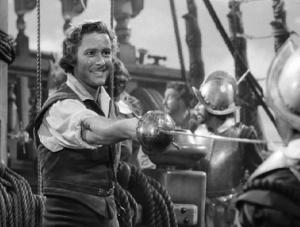
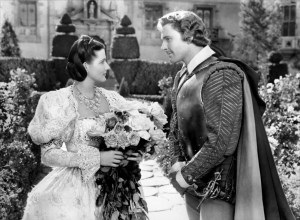
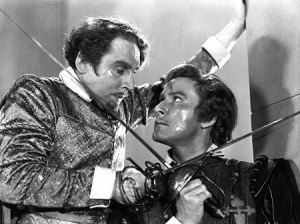
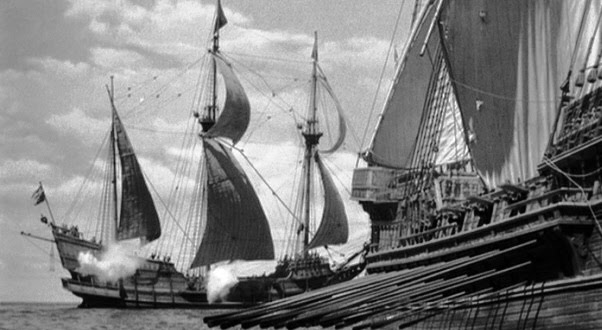
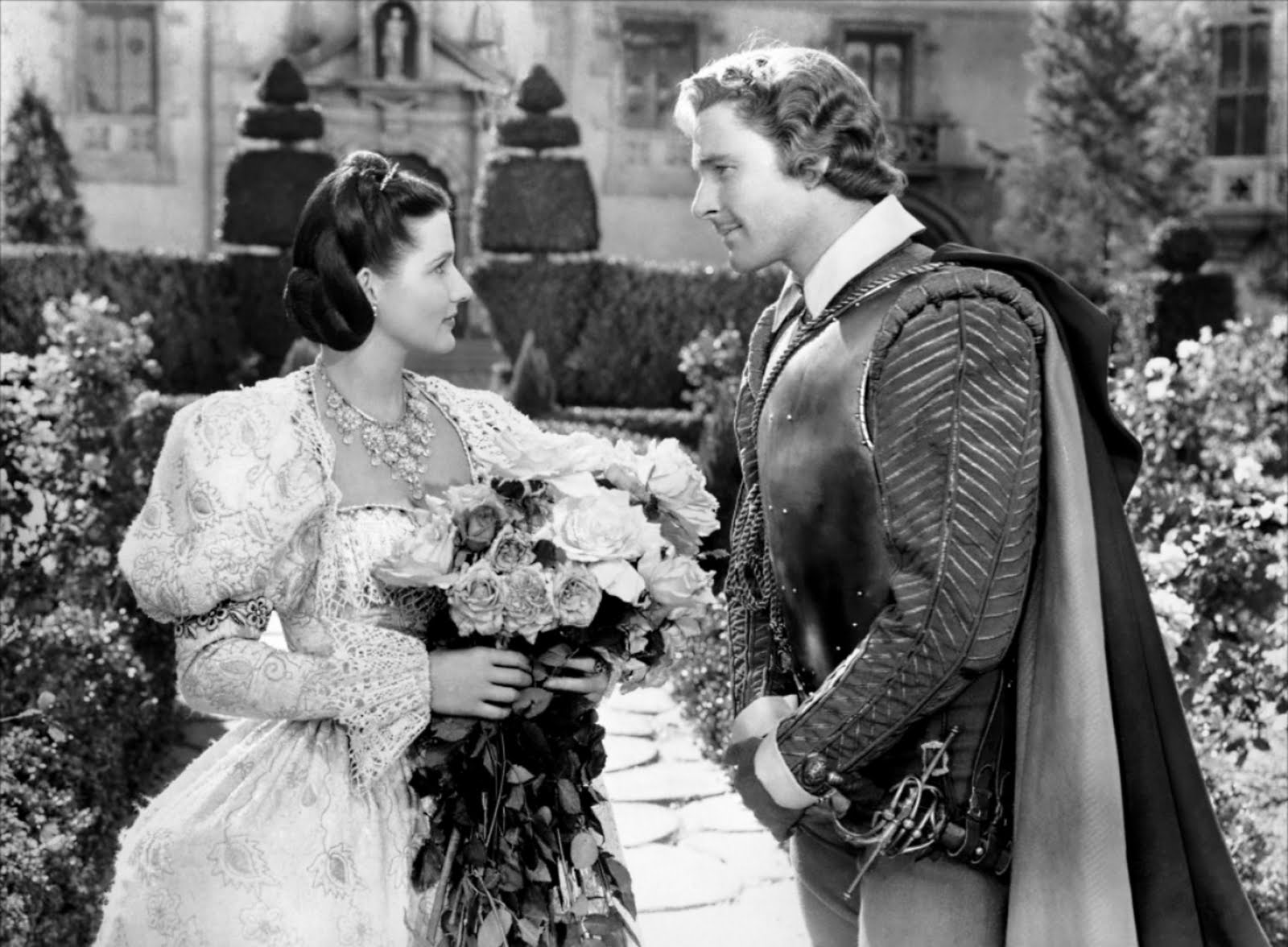
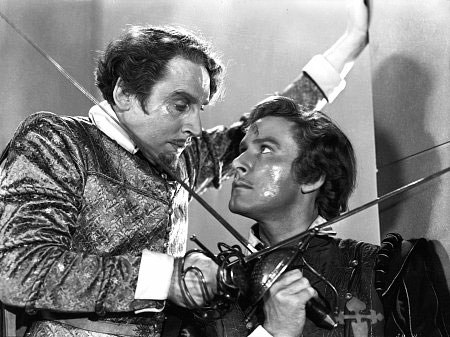
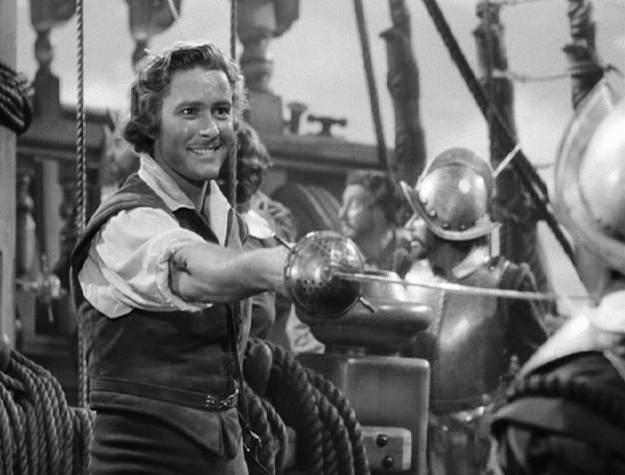
They Died With Their Boots On is the eighth and final pairing of Errol Flynn and Olivia de Havilland. It’s not as famous as some of the others — for example, the pirate swashbuckler Captain Blood or the bejeweled Technicolor storybook Adventures of Robin Hood — but it deserves to be. Those are happy, exuberant movies; this is a tragedy of slowly unfolding power that leaves you unsettled and upset. It’s the rare adventure movie that gets under your skin; it achieves its epic qualities through emotion rather than action. The movie is based on the story of George Armstrong Custer, the general whose command of 500 cavalrymen was overwhelmed by ten times as many Native Americans in 1876. Never were the words “based on” more of a euphemism. As history, Boots On bears only a passing resemblance to actual events — in fact the more you know about Custer, the more outrageous the film’s portrait becomes. Virtually every event is twisted almost 180 degrees in order to turn a vainglorious and highly flawed man into a noble figure.

Yet even as the film moves toward its barroom-painting view of Custer and his men staging their heroic last stand surrounded by savages, it has to explain how he got there. It does so by setting him up as vain, callow, physically daring but reckless and prone to troublemaking. Cleverly, the filmmakers play the first half of the movie as a light comedy, in which Custer gets himself into one mess after another and strikes ludicrous poses trying to act like a bigger man than he is. We see him making mistakes and extricating himself through charm and luck; instinctively we know it’s only a matter of time before that luck runs out.

The fact that the same thing was true of Flynn in real life gives the movie an unusual resonance. He was at least as vain as Custer, and easily as reckless; his road to fame and success was just as fast and fortunate, and left him just as unprepared to deal with real challenges. During the making of this movie, Flynn had a couple of underage girls on his yacht, an escapade that led to a long and embarrassing trial for statutory rape that turned him into a public joke after the premiere — particularly after it was revealed in court that Flynn made love with his socks on. His pre-movie life of adventure had left him with an assortment of chronic maladies that resulted in his being declared 4-F and ineligible for the draft. Because Warner Bros. hushed this up, the public thought him a slacker for not serving in World War II as other stars did. Personal and professional disasters came faster and faster, and his drinking and drug use kept pace. Eventually booze, narcotics, dissipation, and some deeper despair they couldn’t anesthetize, killed him at the age of 50.

Some presentiment of this terrible fate seems to hang over Flynn throughout Boots On. He gives one of his most sensitive and aware performances. His eyes often look wide with fright and he seems more attuned to other actors than usual. Often he pauses and hesitates before taking action, as if genuinely unsure of himself, and when he does act, it’s always a shade too swiftly. He’s as dashing as ever, but often he dashes right into a brick wall. Some of the credit for this must go to the great Raoul Walsh, here directing Flynn for the first time, after the actor had quarreled with his usual director, Michael Curtiz. For the previous seven years, Curtiz had directed Flynn like a toy action figure, throwing him into the middle of clanging swords and galloping horses and trusting him to sail above it all. Walsh’s action scenes were rougher than Curtiz’s, less choreographed and clever, and always suggestive of real threat — as you might expect of a man who had lost an eye in an accident.

At this point in her career, de Havilland had developed some serious ambitions and no longer wanted to be the clinging heroine of Flynn’s boys-own-adventure movies. She only made the film at Flynn’s express request, after they had cleared the air of several years of misunderstanding. By all accounts, including hers, they were seriously in love, but their relationship was undermined continually by his immaturity and instability. Boots On is the only one of their films in which their characters have a real arc, moving from youthful high spirits into a serious relationship, into marriage and ultimately the tragedy of his death. To sweeten the deal for de Havilland, the producer Hal Wallis brought in the fine screenwriter Lenore Coffee for rewrites that rounded out the character of Libby Custer and made her a flesh-and-blood woman rather than a cardboard cutout. De Havilland responds with one of her best and most consistent performances.

In their final scene, she helps him prepare for the battle of Little Big Horn. Both know he’s not coming back, and they can barely look at each other while mouthing cheery sentiments they clearly don’t believe for a second. They’re almost getting away with it when he finds her diary and begins reading it aloud. In it, she confesses her terror over unshakable premonitions of his death. I must have written that every time you left for battle, she says. “Of course,” he murmurs softly. They say their goodbyes and he leaves; she’s rigid against a wall for support. The camera pulls away suddenly from her and she faints from the accumulated tension. Fainting in movies usually is phony as hell, but this time we’ve been holding our breaths too, and it feels like a natural reaction. In real life, de Havilland knew she’d never work with Flynn again, and she felt that he knew it as well. The scene is almost unbearable in its poignancy, for both the characters and the actors. Such is its enduring power that at a screening 40 years later, de Havilland, then about 65, walked out in the middle of it. She went to the lobby, sat down and began to cry.

Suspicion

suspicion

Is he or isn’t he?

That was the question about Cary Grant throughout his life: gay or straight?

This was based, it would seem, on little more than his having shared a house with Randolph Scott in the ’30s and having posed for some goofy pictures of the two of them in aprons and frolicking in the pool. Grant was married five times, had some well-publicized affairs, yet the rumors never stopped, and everyone knew about them. Even my parents. In the early 1960s, they had a live album by Allan Sherman, the singing comedian of “Camp Granada” fame. One of the songs was a riff on a mover and shaker having his secretary call various celebrities, and the big ending went: “And then when you reach Cary Grant, tell him I’d love to, but I just…can’t.” The audience on the album roared; so did my parents.

Around the same time, Tony Curtis did his famous parody of Grant in Some Like It Hot, the humor of which comes not from the accuracy of the impersonation but from the portrait of Grant as a nearsighted, girl-shy millionaire in a silly nautical outfit. Curtis’ very next movie co-starred Grant, so evidently there were no hard feelings. A decade later, when Chevy Chase jokingly used an ugly slur to refer to Grant on a talk show, Grant sued him for slander and won a settlement; later, he was studiously casual about the whole thing. And it continues: a couple of years ago, Grant’s fifth wife Dyan Cannon shot down the rumors yet again in interviews promoting her book about him. But neither Cannon’s testimony, or that of his daughter, his other wives, his former lovers and friends, or anybody else, seems to be enough to put the suspicion to rest.*

Because there’s something about Cary Grant. Whatever he projects at any given moment, he somehow manages to suggest something else at the same time. He’s remembered as the epitome of class and style, but with his strange, not-quite-Cockney accent and thick features, he’s clearly no aristocrat. In his screwball comedies, he projects anger and a kind of general threat to the other actors. His spills and pratfalls are clearly the result of enormous physical mastery and athleticism. Playing heroes in adventure films, he’s a joker and a clown. In love scenes, he’s quizzical, wary, amused — anything but ardent. Often his eyes, his smile, the tilt of his head seem to convey something quite different, and usually more intelligent, than the dialogue coming out of his mouth.

Which is why Johnnie Aysgarth in Alfred Hitchcock’s Suspicion is in many ways the ultimate Cary Grant role. Johnnie is married to Lina, a wealthy spinster from a small English village. He puts the moves on her and they marry quickly, but soon his evasions and subterfuges cause her to have doubts about him. He may have married her for her money (her father thinks so) and be planning to murder her for it too. Or he may be a misguided, misunderstood underdog who’s uncomfortably adjusting to life with a woman who has more money than he does. Is he or isn’t he guilty, that’s what the entire movie is asking. It’s not spoiling anything to tell you the ending (he isn’t), because it satisfied neither the cast, writers, director, original audiences, or virtually anybody else who has seen the movie since its premiere 70 years ago. Everybody struggled with it during the writing and filming — nobody could come up with the right ending. Because there’s no way to resolve this particular story. Suspicion is about something inexplicable: Cary Grant’s personal ambiguity, his elisions, his ultimate mystery.

Joan Fontaine won the Oscar for playing Lina, an award generally assumed to be a consolation prize for her losing the previous year for Rebecca. She basically repeats the performance here, but with more flattering makeup, hair and clothes, and with a veneer of movie-star graciousness that probably drove Hitchcock a little crazy. Making Rebecca, he had used a variety of psychological tricks on set to undermine her confidence. Here, he improvised a nickname for Grant to call her throughout the film: “Monkeyface.” It’s like a slap every time he says it; he might as well be calling her “shithead” in that musical voice of his. Let it be said for the record that Joan Fontaine is beautiful and looks nothing like a monkey, but her role gives her little to do other than suffer and look elegantly worried while keeping a stiff upper. (Lina was a little more masochistically interesting in the original novel, “Before the Fact,” in which she’s correct about her husband’s motivations but so in love with him that she knowingly drinks the glass of poisoned milk he brings her.)

Grant’s real romance in Suspicion isn’t with Fontaine anyway — it’s with Nigel Bruce as his old friend Gordon Thwaite. Considering his snub nose, he has an inappropriate nickname too: “Beaky.” In the 20 years Bruce mumbled and bumbled around Hollywood, he was never more appealing than in this part. Beaky always says the wrong thing and reveals Johnnie’s tricks and lies, and then hangs his head as both the angry husband and the offended wife slap him around. Bruce and Grant get a real performance rapport going — they play their relationship as if Beaky was a big overgrown dog and Johnnie his affectionate but exasperated master. When Beaky has a brandy-induced choking fit and Johnnie stops Lina from coming to his aid, Grant is expertly unreadable. Is he frozen with concern, or callous indifference?

70 years later, it’s not easy to appreciate what a daring performance this was in 1941. Grant had just come off the greatest string of movies any actor ever had — Topper, The Awful Truth, Bringing Up Baby, Holiday, Gunga Din, Only Angels Have Wings, The Philadelphia Story, His Girl Friday — and was now one of the biggest stars in Hollywood. What was bold of Grant was to take the charm that had brought him to the top and suggest that it might in fact be a cover for any number of repellent qualities. Johnnie is handsome, smooth, and commanding, but he’s also a chronic fibber, con man and embezzler… a spider, as the photo at the top suggests. Essentially it’s the darkest role Grant ever played. And though the director claimed (probably falsely) that the studio forced it on him, Hitchcock’s “happy” ending (as with many of his happy endings) is anything but. Lina blames herself for everything, but she’s still married to a man who lies at the drop of the hat and steals money every chance he gets. Johnnie has explained everything away, but he’s still married to a woman who knows what he’s capable of and shrinks from his touch. Contemplating the future of their relationship is actually the scariest thing about Suspicion.


* Why does everyone need Grant to pick a team? Haven’t they heard of bisexuality?   

Viva Las Vegas

A-M and Elvis

Today, Tomorrow and Forever

It’s not difficult to imagine the reaction of Colonel Tom Parker watching the rushes of Viva Las Vegas in early 1964. There he is: Elvis, his only client, His Boy, up there singing and dancing and gyrating as usual. But there’s something wrong. He’s way back in the back of the shot, almost a stick figure back there. Right up in front of the camera, looming in the foreground, taking your eyes inexorably away from him, is Ann-Margret. Or rather, clad in a skin-tight dress and wiggling in unison, Ann-Margret’s butt. I bet the Colonel damn near bit through his cigar.

In fact, Colonel Parker hated Viva Las Vegas. He peppered the MGM front office with complaints: the girl was stealing the picture; she had too many songs and too many close-ups; the director was favoring her and kept adding new material for her; the publicity was all about this great teaming when everybody knew Elvis was the one and only star and doing just fine on his own. Worst of all, the fancy production values and re-shoots were sending the picture over budget, cutting into Elvis’ share: a half-million in salary and 50% of the profits, of which the Colonel was taking 25%.

As usual when it came to anything but cutthroat dealmaking, the Colonel was wrong. Not only was Viva Las Vegas the biggest hit movie of Elvis Presley’s career, but it survives as one of the best of them, and probably the most sheerly enjoyable. It’s not the best movie as a movie (by common consent, that’s King Creole), or the one that presents the essence of Elvis best (that’s Loving You, an under-appreciated minor masterpiece). Vegas’ script is pathetic, its characters one dimensional, its acting perfunctory. Amazingly, it manages to do almost nothing with its ostensible subject (auto racing) or its gaudy setting (despite the title song, performed three times). What makes it great is what the Colonel hated most about it: Her.

What a difference a co-star makes. Unlike most of Elvis’ leading ladies, Ann-Margret doesn’t seem even slightly afraid of him. And she doesn’t make the mistake many of them made, trying to tune into his vulnerable side and get some kind of tender thing going. She’s a tigress. At only 22, she’s a tight little bundle of sheer talent that keeps threatening to burst its seams. She’s so gorgeous she’s like a special effect — days after watching the movie you can’t get her figure or her huge mane of red hair out of your head. Normally Elvis looked at everything and everybody in his movies with the same expression of polite, amiable inattention. But throughout this movie, he reacts to Ann-Margret with something close to astonishment, and his habitual good ol’ boy smirk is replaced by what can only be described as delight. Their chemistry blows the movie to smithereens.

Her energy and his response to it infuse their musical numbers with playfulness and real sexual give and take. The first of them, “The Lady Loves Me,” is set around a hotel swimming pool, as he sings about how hard to resist he is, and she puts him down mercilessly. The lyrics make him out to be pushy and egotistical, qualities Elvis doesn’t project at all, but he makes it work with light self-mockery and the insistence of his attention toward her. By their second number, “C’mon Everybody,” she’s dancing along as he sings, looking up at him undisguised adoration. Her character isn’t supposed to be that much in love with him at this point in the movie, but at this point in the movie, who gives a damn about the script? Not these two, and certainly not us. By the time they dance together near the end — to something called “The Squat” and then to Ray Charles’ “What’d I Say?” — they’re locked in on each other to the exclusion of everything else. The intimacy is so overwhelming you feel like a voyeur.

You feel the same way listening to the two other duets they recorded for the movie. “You’re the Boss” is a great Leiber and Stoller song in which a man and woman trade teasing compliments about each others’ bedroom prowess — the inverse of “The Lady Loves Me.” Leiber was a masterful American lyricist whose style owed something to E.Y. Harburg — both writers were great observers of human foibles, both had sly and witty senses of humor, and both joyfully celebrated the ways sexual attraction makes a person look, act and feel ridiculous. Plenty of Elvis songs simmer with sex, but with Ann-Margret purring and growling along with him, “You’re the Boss” is in a class by itself.

The other duet, “Today, Tomorrow and Forever,” is a love song in standard Elvis ballad style, tremulous and slow. It’s not much of a song, but their rapport lifts it to an almost spiritual level. You can feel the emotion of their real-life love affair in this song, just as you could feel it in the interview she gave Charlie Rose 30 years later, gently but firmly maintaining their privacy as a couple.

You won’t hear either of these performances in the movie, however: the Colonel had the ballad re-done with Elvis singing alone, and the other cut entirely. The soundtrack album didn’t even have Ann-Margret’s name on it. “You’re the Boss,” indeed.

There wasn’t much else the Colonel could do about Viva Las Vegas though; the picture had gotten out of his control and was a total loss as far as he was concerned. However, he had learned his lesson. After shooting wrapped, he signed with Sam Katzman, a producer with absolutely no taste but an ironclad commitment to bringing pictures in under budget. A kindred soul. From now on, Elvis movies would have lower costs, tighter shooting schedules (two weeks, down from the 11 weeks spent on Vegas), hand-me-down songs, no big production numbers, and nobody of sufficient talent to turn the boy’s head. In his next picture, Kissin’ Cousins, he would be his own co-star — he played an Army man who discovers a look-alike hillbilly cousin in the backwoods mountains, tackily re-created on a soundstage. The psychological effect of this doppelganger plot on a man with a dead twin brother and a deep inferiority complex can only be guessed, but it was a glum shoot and there were times Elvis refused to leave his dressing room.

Kissin’ Cousins cost only $800,000 to make, and earned $2 million in profit. Now there, the Colonel must have thought as he fondled his cigar, that’s a picture.

An Open Letter to Herman Cain

Dear Mr. Cain:

Congratulations on your spectacular rise to the top of the current Republican presidential field this past week!

I understand that when reporters suggested you’re the Flavor of the Month, you replied that they should call you “Haagen Dazs Black Walnut.”

And that you added this was because “it tastes good all the time.”

As a marketing communications professional, may I offer you some advice? Full disclosure: I am a member of the other Party. But still, I promise you’ll find it pretty solid.

First, you should refrain from comparisons of yourself to any sort of nut, or nut-based item. All things considered this is just basic common sense.

Also: everyone knows you’re black. No need to keep mentioning it. Point taken, sir.

In fact, generally speaking I’d avoid mixing up racial and food metaphors—it’s a slippery slope. Pretty soon you’ll find yourself saying you’re Deep Carob Crunch whereas Obama is Vanilla-Chocolate swirl, or something. And it won’t end well.

In fact, with your background in pizza chain restaurants, you should stay away from food metaphors altogether. Again, you don’t want to get into any kind of “anchovies on the side, hold the pepperoni” kind of thing.

In this same vein, any references to how you taste, no matter how delicious, are just not Presidential.

I understand that reporters are going to try to lead you there. They’re looking for a headline. “Sweet Cain Likes His Sugar on a Stick.” “Poor Get No Piece of the Pie, Says Cain.” “Put a Fork in Him—He’s Done.” That sort of thing. They have no shame. But that doesn’t mean you have to enable them.

Probably you’re wondering, what should I have said when they asked me if I was Flavor of the Month? Well, something like this:

“No indeed. I am a serious contender for the Republican nomination, and I believe voters are ready for some really simple solutions to complex issues.”

Try this new, non food-based approach to answering press questions, and see how it works for you.

Warm regards,

Eddie Selover

Libeled Lady


It’s amusing to think that the most elegant and sophisticated couple in film history met in the back seat of a car. Myrna Loy and William Powell were making Manhattan Melodrama, a movie as formulaic and dull as it sounds, and the director W.S. Van Dyke was in a hurry as usual. “My instructions were to run out of a building, through a crowd, and into a strange car,” Loy wrote 50 years later. “When Woody called, ‘Action,’ I opened the car door, jumped in, and landed smack on William Powell’s lap. He looked up nonchalantly. ‘Miss Loy, I presume?’ I said ‘Mr. Powell?’ And that’s how I met the man who would be my partner in 14 films.”


The key word in that anecdote is “nonchalantly.” That was the style Powell and Loy developed in the mid-’30s—cool, dry, and airy despite whatever melodrama, Manhattan or otherwise, happened to be unfolding around them. In fact, the more dramatic the situation (for example, a wife catching her husband with another woman, or someone waving a gun around) the more distant and amused they became. Trapped, like all the other actors of their generation, in clichéd plots and by-the-numbers scenes, they looked at each other skeptically — he with lips pursed, watching to see how she would react; she with narrowed, suspicious eyes as if he had arranged it all in a transparent, failed attempt to please her.


Their impact was so strong that their detached superiority itself became a cliché — dozens of actors from Dean Martin to Maggie Smith to Bill Murray have used it over the years to signal cynical disbelief at the movies they’ve been stuck in. What Powell and Loy had that nobody ever quite duplicated was a deep mutual understanding and respect. They were peerlessly adult and worldly (they were never called by their first names, like Fred and Ginger — that “Miss Loy” and “Mr. Powell” is very telling). But they weren’t stuffy about it. They may have treated the plots and characters around them as a private joke, but they locked in on each other with tremendous focus. After their first film, Van Dyke paired them in The Thin Man, which made them a world-famous team and bonded them forever in the public’s mind. But it’s their fifth film, Libeled Lady, in which their romantic chemistry is at its most potent and moving. It’s probably their best movie.


One measure of how wonderful Powell and Loy are in Libeled Lady is that they turn the other actors into run-of-the-mill supporting players. When your co-stars are Jean Harlow and Spencer Tracy, that’s saying something. Harlow and Tracy play the contrasting couple — the floozy and the tough mug who go toe-to-toe with the two urbane sophisticates. They’re good, but in this case they’re not in Powell and Loy’s class. The movie was made a couple of years after the enforcement of the Production Code, when MGM was trying to fashion a new persona for Harlow. She had become famous playing trollops, poured into skin tight satin gowns, her unworldly platinum hair and hard, angled face shining in the key light. Once the Code was in force, they began to tone her down, and here she has evolved into a fairly standard movie tart: loud and ungrammatical, but with a slightly dinged heart of gold. Harlow gets top billing in Libeled Lady, and she’s capable and likable, but she’s also a bit tiresome as she stomps her feet and launches into yet another tirade.


I don’t know what to say about Tracy. Katharine Hepburn once compared him to a potato (she meant it as a compliment), and that’s pretty apt. He’s solid and meaty. He’s there. But he’s not very exciting. There’s a case to be made for Tracy as the most overrated actor of his generation; he’s still considered some sort of giant, but it’s more residual reputation than actual achievement. He never could play comedy, or more accurately, he wasn’t personally funny aside from whatever business or line they gave him. In comedies, he tended to act like an overgrown puppy, putting his head down, looking up with his big brown eyes, shuffling and stumbling, raising his voice to bark at the other actors. In Libeled Lady, he plays a standard ’30s part—the ruthless, manipulative, anything-for-a-story newspaper editor. Cary Grant made the same character charismatic and hilarious in His Girl Friday, but the best Tracy can manage is to be a good sport.


Here’s the plot: Loy is the richest girl in the world, who is suing Tracy’s paper for libel over a false story about a romantic entanglement. The suit would ruin the paper, so Tracy hires Powell to seduce Loy and put her in a compromising position; in order to make Loy look like a homewrecker, he convinces his own fiancée Harlow to marry Powell… platonically. It’s a tightly woven farce plot, none of it very original even at the time, but it serves to keep the four stars at cross-purposes so they can bicker and double cross each other. It’s like the ancestor of a sitcom. The director was Jack Conway, an anonymous MGM hack whose chief virtue was that he knew how to keep things moving briskly. Libeled Lady is almost a perfect catalog of ’30s movie comedy situations and devices — people bite each other, elegant gowns are kicked away impatiently, insults are hurled and then topped. As written by Maureen Watkins, the author of Chicago, some of the wisecracks are pretty good — for example when Harlow complains that someone talked to her like a house detective. “How do you know what a house detective sounds like?” Tracy demands and she fires back: “Doncha think I read?”


What makes Libeled Lady memorable is the delicacy and heart of Powell and Loy’s playing. At first, of course, they’re adversaries. Hired to make love to her, he begins by trying to ingratiate himself with her on a trip on an ocean liner: isolating himself with her, subtly arranging for physical contact, telling her what beautiful eyes she has. As he comes up with one sleazy strategy after another, she regards him with infinite and increasingly open shades of distaste. Her father (Walter Connolly, the perennial sputtering father of screwball comedy) is an avid fisherman, so Powell works that one, pretending to be a fishing expert. When Connolly excitedly tells Loy that Powell is an angler, she replies that yes, he seems like quite an angler. This leads to an extended scene in which the three go trout fishing in a raging river, and Powell takes a series of pratfalls and spills while trying to appear like a world-class fisherman — he has a very wet instruction book in his creel basket, though he can’t hang onto it for long. One of the great comic sequences of the decade, it led to Howard Hawks making an entire movie around the same premise called Man’s Favorite Sport? (unfortunately, Rock Hudson was no William Powell).


Eventually, Powell’s pursuit of Loy leads to them falling genuinely in love, and at that point something wonderful happens. With all the mechanical farce conventions ticking away around them, you expect him to be exposed, and he is. You’re ready for the inevitable confrontation, hurt feelings, and breakup that lasts up through the final explanation and forgiveness, but it never comes. She instantly understands what’s happened, and there are no recriminations…even though he’s still technically married to Harlow. Powell and Loy are too mature, too wise, too grown up for tedious spats. Audiences loved The Thin Man movies, and still do, for their portrait of a witty, companionable marriage full of teasing and wisecracks. Libeled Lady shows the courtship phase of that same relationship, and it’s as satisfying as you always hoped it would be.


First published on Edward Copeland on Film.
 

Dodsworth

The Beautiful American

Why isn’t Dodsworth better known, even among film buffs? It premiered in 1936 — a great year for movies — and it was nominated for the best picture Academy Award. Maybe if it had won, as it deserved to, more people would be aware of it. The actual winner, an endless, tedious “musical” biography called The Great Ziegfeld, would almost certainly be forgotten today without the dubious distinction of a best picture Oscar. Dodsworth’s other unrewarded nominations were for actor, screenplay, direction, supporting actress, and sound recording, and it should have won the first three as well. The only Oscar it did receive was for Richard Day’s outstanding art direction, which conjures up a trip across Europe on a series of Los Angeles sound stages, subtly echoing and intensifying the emotional states of the characters in any given scene.

The story is about Sam Dodsworth, an auto tycoon who has just sold the company that bears his name. We first see him as he stands alone in his office looking out over his factory, with a newspaper announcing the sale…and then as he walks through a crowd of employees who offer their thanks and goodbyes. Due to the immense skill of the director William Wyler, we learn a great deal about Sam in these brief, wordless moments. In the first shot, his slightly slumped and motionless posture expresses his regret, and the fact that he has his back to us makes him seem remote and slightly larger than life. His back is still to us in the next scene, but the camera is tracking close behind, so we experience his point of view as the huge group of blue collar auto workers parts slowly and respectfully. We understand that Sam is a good and beloved man, a leader, who is on the cusp of a major life change and full of mixed feelings about it. We like him and identify with him before we’ve even met him.

He’s driven home, taking a last look at the factory receding behind him. At his big, luxurious but cavernously impersonal house, he’s greeted by Fran, his wife. Fran, at least, has no regrets about Sam’s retirement. She tells him that they’re free to start life over from the beginning and she’s eager to go to Europe and leave behind “this half-baked Middle West town.” She’s spent the past 20 years raising their daughter and being a dutiful wife, belonging to dull women’s clubs and keeping up appearances. It’s supposed to be a pep talk for Sam’s sake, but there’s an edge of self pity and resentment in her voice; she brightens up when he calls her on it. She wants to start enjoying life, that’s all, while she still can. After all, she says, “no one takes me for over 32 — 30 even.” And in Europe, a woman such as her is just getting to the age when a man starts taking a serious interest in her. Sam reacts to this ludicrous assertion with a blend of incredulity, awareness and affection, but he doesn’t challenge it. He adores Fran and he’s ready to indulge her and learn more about Europe while he’s at it.

And so the stage is set. You can feel what’s about to happen. The Dodsworths are a happy, devoted couple, but for 20 years that happiness has depended on their roles — he’s had his company and his career, she’s had their daughter and social position. Now, in middle age, the differences are starting to show. He’s open-minded, curious, action oriented, plain spoken and direct, and the giver in their relationship. She’s judgmental, superficial, deeply unhappy with herself and taking it out on others. The movie shows the fissures in their relationship widening sharply and alarmingly, with his patience and affection tested by her deluded and increasingly reckless behavior. She starts out by flirting with gigolos and ends up in full-blown affairs with wildly inappropriate men, subtly and then openly blaming Sam for it all because he’s middle-aged and unsophisticated.

On the surface, Dodsworth is a calm, decorous drama about the troubles of two rich white people, but just below the surface, it’s an emotional horror story. Fran isn’t the monster, exactly. It’s her selfishness that’s the beast — and it does as much damage to her as to Sam. “I’m ashamed deep down inside me,” she tells him after her first shipboard flirtation leads her into deeper waters faster than she’d expected. “I don’t trust myself. I’m afraid of myself.” Ruth Chatterton, who plays Fran, gives these lines a harrowing urgency and truth, as she lets us see the baffled, suffering person beneath the foolish, phony-baloney surface. A serious, somewhat upper-crust and “dignified” actress, she achieved greatness just once, with this performance. Not that it helped. Chatterton was 43, a shade too plump, and fiercely intelligent. Three strikes and you’re out—this was her last appearance in an American film. She didn’t even get nominated for an Oscar, probably because her dead-on portrait of vanity and self-deception made a lot of people in Hollywood very uncomfortable.

Walter Huston, as Sam, did get nominated, and won the New York Film Critics’ award for best actor. He’d played the role on stage and was legendary in it, but there’s no trace of staginess in his film performance. It’s not all that easy to play a virtuous character, and Sam isn’t just virtuous but a wealthy captain of industry without a trace of greed, ruthlessness or ego. Unlikely, to say the least. Huston disarms us and draws us in by showing the eager young boy who still lives inside the 52-year old man. Sam’s enthusiasms are sudden and unguarded, and so is his vulnerability. He’s not a fool — he has a shrewd understanding of other people, and nothing much gets past him. There have been lots of movies about the Ugly American, but Dodsworth is the Beautiful American encountering corrupt, cynical, decadent old Europe. He’s the idealized American of a vanished age, the sort of guy Ronald Reagan was playing when he acted the part of the president: tolerant, wryly humorous, deceptively tough and patient with the failings of others…to a point. Except that Sam actually begins to crack under the unrelenting pressure of his wife’s emotional abuse, and as played beautifully and sensitively by Huston, he goes through some very convincing stages of grief.

The third great actor in Dodsworth is Mary Astor, playing Edith Cortright, whom the Dodsworths meet on the boat to Europe. Divorced and rootless, she lives in Italy because, she says frankly, it’s cheap. Like Fran, she has reasons to be bitter…but unlike her, she has accepted life’s inevitable disappointments and found a way to live with them. She’s open and direct like Sam, and becomes a friend to him as Fran begins to pull away. By the end of the film, the movie is all Astor’s, and you just want to be rid of Chatterton. In her memoirs, she noted that Chatterton was unhappy with her role, and fought with Wyler, because like Fran, she was faced with losing her youth. Interestingly, both actresses turned to writing novels when their acting careers dried up. In contrast to Chatterton, of course, Astor got the chance to prove her immense talent in dozens of movies over four decades, usually as a very complicated woman: Red Dust, The Palm Beach Story, The Great Lie, The Maltese Falcon, Desert Fury, Act of Violence, A Kiss Before Dying, and Return to Peyton Place (no, really) among them. Here, like Huston, she pulls off the difficult task of making decency interesting. She has a wonderful moment when she accidentally catches Fran murmuring sweet nothings with Arnold Iselin (Paul Lukas), a Eurotrash “financier” and ladies’ man. Edith, who really does have the old-world sophistication Fran tries to fake, sizes up the situation immediately. “My dear,” she says softly and gravely, looking Fran in the eyes, “don’t.” Astor gives this single word of girl-talk warning all the impact of a sudden smack in the face.

In real life, Astor was undergoing a personal ordeal during the filming of Dodsworth: her divorce and custody battle were getting ugly and a purported diary full of lurid sexual details was leaked to the press. Years later, she said that playing Edith Cortright saved her — that she drew on Edith’s serenity and groundedness throughout the court case and its screaming headlines (Chatterton sat with her in court for support). Among other things, Astor underwent the humiliating experience of being called to producer Samuel Goldwyn’s office and being grilled about it by all the major studio heads, for whom she was a popular free-lancer. To his credit, Goldwyn kept her on the picture. In fact, the whole movie — a courageous exploration of serious themes without big stars or any other box-office concession — is to his credit. It wasn’t a financial success, but it was an artistic one; in a career full of tripe and misfires, this film and The Best Years of Our Lives are Goldwyn’s monuments.

Dodsworth could have been made today, except for the sad fact that movies this beautifully written, directed and acted are even rarer now than they were then.

My Man Godfrey

Games With Human Beings as Objects

The opening of My Man Godfrey constitutes a little movie in itself — a perfectly balanced mixture of satire, wit, anger, and glamour that may be the greatest single scene in 1930s cinema. It starts with the credits, which are integral to its meaning. We see the Manhattan skyline at night, and to a fanfare the names of the cast and crew light up in neon signs that flash on and off, reflected in the East River below. The camera pans across buildings that slowly become less grand, more industrial, more forgotten and squalid, and finally it comes to rest at the city dump underneath the end of the Queensboro Bridge. The brash music subsides into the first few plaintive notes of the Depression anthem “Brother, Can You Spare a Dime?” The camera moves in and we see a lonely shanty, a hobo tending a fire, a dog sniffing through the trash. A dump truck backs up and adds more garbage to the pile, a cascade of cans and rubbish that glitter like diamonds in the moonlight. And then we see him. The hobo tending the fire, we discover, is William Powell.

Even today, it’s a bit of a shock to see this actor playing a bum. Powell, the epitome of class, the man about town who wore clothes beautifully, smoked and drank cocktails with peerless elegance, and spoke with impeccable clipped diction. With one twitch of his pencil-line moustache, William Powell could register infinite degrees of skepticism and wry sophistication. And here he is, bearded and shabby, speaking in a low, hushed, defeated tone of voice. He trades a few bitter observations with another bum as a couple of snazzy cars pull up at the edge of the dump. Three well-dressed people rush out: two women and a man. The women are sisters, played by raven-haired Gail Patrick and blonde Carole Lombard. The darker one, Patrick, gets to Powell first. How’d you like to make five dollars? she asks. Powell doesn’t quite get it. Brusquely, she offers the money again and tells him all he has to do for it is go with her to the Waldorf Ritz hotel where she’ll show him off to some people. She’s on a scavenger hunt and her next item is a Forgotten Man — the evocative, accusatory Depression-era term for a homeless person. Do you want the money or don’t you? she snaps at him. That’s enough. He advances on her with barely controlled aggression, his voice quiet but vibrating with resentment. She falls back and lands on her ass, then runs off in fear with her escort. Powell, still furious, strides in the other direction and runs smack into the blonde.

Her name is Irene, she tells him, and that was her sister Cornelia and she’s always wanted to do what he just did — push Cornelia into a pile of ashes. He offers to push her in too, and now she’s the one to decline the offer, but not angrily. She’s a ditz, rattling off disconnected observations and thoughts a mile a minute. The moonlight illuminating her fluffy head of hair and shimmering satin gown, she’s like an angel come to rest on the dump. Powell’s irritation turns to curiosity. Would you mind telling me just what a scavenger hunt is? he asks. She takes a deep breath. “Well, a scavenger hunt is exactly like a treasure hunt, except in a treasure hunt you try to find something you want and in a scavenger hunt you try to find something you don’t want.” Like a Forgotten Man, he says. “That’s right, and the one who wins gets a prize, only there really isn’t any prize, it’s just the honor of winning, because all the money goes to charity, that is if there’s any money left over, but then there never is.”

With this and her other long screwball speeches in this movie, Lombard plays a subtle trick, her voice trailing off at the end as her character becomes vaguely aware that something is wrong. It isn’t that she’s dumb. She’s infantile. She has grown up in a bubble, insulated from the world by her wealth. Ease and luxury have stunted and stupefied her. Confronted with Powell’s steady gaze, her voice begins to wobble and her scattered attention focuses on him, like a baby seeing its parent and calming down. So they sit and talk, the rich girl and the bum becoming interested in each other. It even makes her philosophical. “You know,” she says, “I’ve decided I don’t want to play any more games with human beings as objects. It’s kind of sordid when you think of it, I mean when you think it over.”

This little quip goes by in a flash, but it’s amazing when you think of it. I mean when you think it over. Like the whole scene, it expresses a bristling sense of moral outrage. The Forgotten Men come out of the shadows after Powell threatens to punch Cornelia’s top-hatted escort, asking if he needs any help. They’re a little society, watching out for each other, keeping their dignity despite being literally at the bottom of the heap. In an era and an industry in which conservative values dominated (don’t they always?), here is a full-throated cry of humanism and populism. The movie makes us vaguely, uncomfortably aware that we’re tourists, just like the three rich people. We’re drawn to Powell by his toughness, his intelligence, and his irony, but we’re also a little appalled. He looks like shit. He lives on a garbage heap. How did he get here? And how can he — and we — get out?

The rest of the movie is the answer to those questions, and it’s not an entirely satisfying answer. Lombard takes Powell back to the scavenger hunt, wins the prize, and hires him to be her family’s butler in their Park Avenue mansion. It’s a screwball comedy out of P.G. Wodehouse: the level-headed servant civilizes the house full of wacky rich people, and the boy and girl fall in love. Although the rich are satirized and vilified, and the value of good honest work is celebrated, the movie can’t sustain the brilliance of its beginning. It’s well acted by a team of expert farceurs including Eugene Pallette, Alice Brady, and Mischa Auer. It looks great, with its sleek art deco sets and sparkling cinematography by Ted Tetzlaff. And it sounds great, with its flow of wisecracks by Marx Brothers writer Morrie Ryskind, but in the attempt to create a box-office romance, something goes awry with the plot. We learn that Godfrey, Powell’s character, is actually from a wealthy family himself, but a broken love affair left him devastated and he fell into poverty and homelessness because he didn’t care what happened.

This is a major letdown — we’re supposed to be soothed by this reassurance that Powell is “respectable,” but in fact we were much more on his side when he was a bitter bum of ambiguous origins. The romance between Godfrey and Irene works only because Powell and Lombard, real life ex-spouses and good friends, have genuine chemistry. Unlike most comedies of its era, in this movie the man is much smarter than the woman, and just like in real life, that’s not very romantic or particularly funny. On Park Avenue, the movie is pleasant and enjoyably proficient, but back on the city dump it was, briefly, extraordinary.

Joan Crawford: If You Want to See the Girl Next Door… Go Next Door

joan%20crawford%2002a

More than anything else, it was a book that turned me into a movie buff: David Shipman’s The Great Movie Stars: The Golden Years. This was the first comprehensive set of star biographies, and in those pre-video days of the early ’70s, it told tantalizing tales of films I had no hope of seeing unless they turned up on the late show. Shipman wrote marvelously about many actors and actresses, but maybe too well — his opinions had a way of soaking in. The actors he cared about (Judy Garland, Buster Keaton, Greta Garbo, Deanna Durbin) got love letters, while those he didn’t were pretty much excoriated.

Joan Crawford was one of the latter. The entry on Crawford starts with a putdown by Humphrey Bogart, and Shipman goes on to call her “not much of an actress…as tough as old boots” and to conclude that “she achieved little…her repertory of gestures and expressions was severely limited…(her shoulders) were always so much more eloquent than her face.” And that’s just the introduction. His survey of her career is peppered with words like “artificial,” “heavy,” “monotonous” and “hysterical.” So even before I’d seen most of her work, I was a bit prejudiced against Crawford.

When I finally did, she made it hard to disagree. Her appearance, for one thing. Increasingly through her career, she covered her face in grotesque Kabuki makeup — huge outsized lips, big Groucho eyebrows, piles of dead-looking hair. Her body language was stiff and somewhat mannish, and she did throw her shoulders around a lot. She was especially fond of squaring them off when confronting some hapless male — often a weakling such as Van Heflin, Zachary Scott or Wendell Corey. Although, to be fair, she made most men look weak, even big macho guys such as Jeff Chandler, Jack Palance or Sterling Hayden. When she turned her huge, furious, reproachful eyes on them, they all seemed to shrivel. So did I. If a movie star is someone you idly daydream about making out with, Miss Crawford did not do it for me.

Maybe I just needed to grow up, because sometime in my 40s, I started to change my mind. By then I’d seen some of her best work: Possessed, Grand Hotel, The Women, Strange Cargo, Mildred Pierce. Of course, in these movies she had vivid co-stars and wasn’t the whole show; I still didn’t think she was a very good actress, or even particularly attractive. What finally turned me around was Humoresque. It’s a big, thundering ’40s soap opera about a struggling young violin prodigy from the New York ghetto (John Garfield) who is taken up socially, artistically and sexually by a rich older married woman. This role is a field day for Crawford, who gets to fling diamond-hard insults (written by Clifford Odets), ride a horse passionately, have an orgasm during a violin concerto, smash martini glasses against the paneling of swanky bars, and walk into the surf in full evening wear. Ridiculous. And yet she’s gorgeous to look at and completely persuasive as an actor. At every moment, she makes you aware that this is a woman who doesn’t like herself, whose loveless marriage for money has left her bitter and empty. Her awakening from cynicism into love, and her desperate awareness that it’s come too late to help her, is finally quite heartbreaking.

She was a hard woman, no doubt about it. She had a terrible childhood — abandoned by her father, carted around the slums of El Paso by her impoverished mother, learning much too early that men were a meal ticket and what the price of that ticket was. She was rumored to have made a stag film, to have been a stripper and a hooker. When she arrived in Hollywood in her early 20s, one observer remembered her as “an obvious strumpet.” Show people can be terrible snobs and the unconcealed disdain of her colleagues must have marked her deeply. Her whole life seems to have been an effort to scour off the dirt of West Texas and make a lady of herself. More than most performers, she kept reinventing herself and assuming new identities. Born Lucille LeSueur, she became Billie Cassin and then Joan Arden before the studio ran a contest to come up with Joan Crawford. She often spoke of how the movie industry educated her about virtually everything. When you watch her, you can feel the untold hours of effort she has put into her appearance, her diction, and her carriage, to covering up her dark, freckled skin. Much of her falseness comes from this fierce determination to be someone else — someone better.

But it’s also where her power comes from. For example, in Strange Cargo, she plays a prostitute in everything but name (the Production Code was in full force). Although she was at the height of her stardom, and working with Clark Gable in his first movie after Gone With the Wind, she gives absolutely no quarter. Her wardrobe consists of three print dresses that reportedly cost a total of $40 (and she looks fantastic in them). Whatever her own experiences, she makes a mighty convincing whore — cold and hardened on the surface, bitter and hurt underneath, and deeply wounded and desperate at the core. She has a great moment where she tries to pretty herself up a little bit after days of crawling through the jungle, and Gable mocks her in the cruelest and most disrespectful way. She maintains her toughness with him, but as Frank Borzage’s camera moves slowly in on her, she lets you see the immensity of her shame and self-loathing. She handles the character’s transformation into a sweet and hopeful woman very subtly and convincingly as well. At no point does she signal that she’s a big star, or a lady pretending. She doesn’t ask for sympathy — she earns it.

Crawford didn’t act in many comedies, and when she did she was often completely humorless (They All Kissed the Bride, a misogynistic screwball farce intended for Carole Lombard, is Exhibit A). She did have a sense of humor, but it was too black and caustic to work in the frothy nonsense of her era. However, just once she was awesomely funny: in The Women, playing a comic version of her own tough persona. She plays Crystal Allen (a wonderful name for a hard, glittering woman). In her first scene, she’s on the phone with her married lover, who is trying to cancel his date with her to be with his family. On the phone, she’s a parody of a sweet innocent young thing. But fending off the interjections and insults of her disbelieving co-workers, she’s matter-of-factly rapacious and cynical. When she finally gets him to cancel on his wife and come to her place instead, she does a silent little shoulder-shaking fist pump of victory… the kind of moment that makes you fall in love with a performer. “How do you like that guy?” she snaps, and then spitting out the last word: “He wanted to stand me up for his wife!”

Let’s also take a moment to consider her fine work in Grand Hotel, the first all-star film. She shares much of her screen time with John and Lionel Barrymore, acting royalty of the time, and she’s pretty much their equal. It’s not saying much in Lionel’s case, I know, but she’s great with him. He has a banal role: a meek desk clerk who’s dying and on a last spree, and as usual he overdoes it and acts all over the place. Crawford’s secretary is at first professionally kind and slightly amused, later genuinely interested and concerned, and finally loving and protective. They have the only happy ending in the movie, and again, she earns it. In the meantime, with John Barrymore she’s poised, if a bit self-conscious… until they too make a connection based on mutual disenchantment. She also has a terrific scene with Wallace Beery in which she tacitly agrees to be his mistress and subtly masks her visceral disgust with a brilliant smile. Great stuff. Greta Garbo is the other star of the film, playing a prima ballerina with grotesque theatricality (she’s prima, all right), leaving Crawford the clear winner among the five of them.

Ten or 15 years after Grand Hotel, all her co-stars were gone, but she kept going for another 40 years after that movie.  Something not generally mentioned about her is that she ran a long career with imagination, taste, and self-awareness. Entering the decade of the 1950s at the age of 44, a former silent star like Norma Desmond, she was far from washed up… in fact she became more protean than ever. She went to Columbia to be perfectly cast in Harriet Craig as a control freak who controls her household with an iron fist and her husband with a velvet glove. She put together an independent vehicle, Sudden Fear, and got an Oscar nomination for her bravura work in a tightly wound and very tricky thriller. Next she made a bona fide masterpiece, Nicholas Ray’s geometric, operatic Western Johnny Guitar — another movie she put together as a package, including the property, script, and director. Stories of her temperament on the set dominate most discussions about it, but she deserves more credit as its co-creator and for her gender-bending performance as the tough-as-nails protagonist. In case that sounds like typecasting, let it be noted that soon after she gave an untypical and beautiful performance as a shy spinster finding love in Autumn Leaves, convincingly vulnerable for a change, and making you feel her confusion as she’s forced to find some inner strength. And she ended an impressive decade with The Best of Everything, a gorgeous and hugely entertaining movie that uses her fierceness very cleverly, as Hope Lange’s Boss From Hell who’s actually as abused and misused by men as the trio of younger women she’s terrorizing.

And we haven’t even gotten to Mildred Pierce, her most famous and Academy Award-winning role. Earlier this year, in HBO’s epic miniseries, Kate Winslet played Mildred exactly as written by James M. Cain — a mixture of likable and dislikable qualities. Mildred is plucky, determined, indomitable and cunning but also naïve, clueless, misguided and weak. This is not the woman Joan Crawford played. Her Mildred may be determined, but she has only the noblest intentions. The drama of the movie is the series of betrayals and humiliations Mildred undergoes at the hands of virtually everyone she trusts. Every single scene builds to a dramatic climax and then ends with a payoff, and they keep coming boom! boom! boom! It’s probably the best-made movie she was ever in, and while it might not be her best performance, she’s perfect for it because her steely determination is consistently misplaced, off-point, self-destructive, and thwarted. Many commentators over the years have pointed out the obvious irony of Crawford, the abusive virago of Christina Crawford’s Mommie Dearest, winning an Oscar for playing an over-indulgent mother whose only sin is loving and spoiling her daughter to excess. But clearly it was more complicated than that — Joan and Christina’s relationship seems to have been a pitched battle of wills that extended beyond the grave. Something many of us can relate to, in fact.

But Joan Crawford didn’t want complexity. Life, as she knew better than most, is a messy, dirty, terrifying business. Her response was to envision something better, and go after it with laser-like intensity. In 1931’s Possessed (the first of two movies she made with this title), she plays a poor girl in a working class town who can’t reconcile herself to marriage to a cloddish boyfriend and a life of drudgery. One evening, a train pulls into town. She stands there in her cheap dress, looking at the train windows as they pass slowly by, revealing a series of elegant tableaux: rich passengers dressing up, dancing, drinking cocktails, being attended to by servants. Her longing is palpable. She’s still years away from becoming the implacable survivor staring down the world, stubbing out cigarettes and torturing Hope Lange. She’s young and full of hope, and you’re with her all the way when the next scenes show her penniless but ready for anything in New York, having decisively left her squalid life behind her.

Of course, we don’t leave ourselves or our demons behind when we try to move onward and upward — that’s only in the movies. Shipman’s book includes a famous put-down of Crawford’s unnuanced acting by F. Scott Fitzgerald, who wrote screenplays for her during the ’30s. He missed the larger truth about her, the larger performance that her life was all about. He’d have recognized her if he’d looked more deeply, because in her unwavering faith that poise, money, and class can erase all the compromises necessary to achieve them, Joan Crawford was as quintessentially American as Jay Gatsby.