Watching You

“What is this salty discharge?” — Jerry Seinfeld, crying for the first time, on Seinfeld.

Something strange has been happening to me lately. I’m developing empathy.

Once in my 30s I had a calendar for Geminis that described us as “good listeners… as long as you’re interesting” and I had to laugh, because that pretty much nailed me. For most of my life other people fell into two categories: interesting, and not. Those in the “not” category barely existed for me — they were formless blobs who had to really get in my face to even come into focus.

I wasn’t some kind of psycho; I managed to get married, have friends, raise a kid, and I think I was pretty present in relationships.

But for the most part it was as if a glass wall existed between me and other people. The wall, I suppose, was my judgment and control, which in turn were driven by a deeper sense of powerlessness and fear.

I turned 50 a year and a half ago. It was a trauma. How could I be 50? I mean, I dug the benefits of getting older: more wisdom, more poise, better judgment. But in my mind I was more like a 25 year old who was getting very cool. The idea that I could no longer be considered young by any objective measure was pretty sobering.

On the heels of that came a few serious difficulties and intense life changes that I won’t go into here, coupled with deeper spiritual practice including meditation and yoga.

And lately, more and more, everyone is interesting. I find myself much less focused on advancing my agenda and point of view, and instead just watching. Really paying close attention to people, noticing the tiny flickers of expression that cross their faces, listening to the gaps and pauses between their words, and hearing what they’re really saying.

And it’s breaking my heart a little bit, because what I’m seeing so often is that powerlessness and fear in them. The harsh self judgment, the shame, the anxiety. The little child that’s still there, innocently looking for love and validation (thanks for the video, Mina), and so often not finding it. What William Blake was talking about in “London.”

It’s changing me. Like a couple of weeks ago when our dishwasher broke and I had all kinds of crazy difficulties with HH Gregg. I ended up in the store with my fistful of paperwork, righteously and justifiably pissed off, engaging in a tug of war with a pompous middle manager over their policies and procedures.

At a certain point, I stopped talking, and started watching.

The middle manager just wanted to be right. He had his little square of turf, and on that turf he was the king. He had a few things to say. And I realized that he was going to give me everything I wanted, but only after he made his little stand. So I let him. It didn’t cost me anything (except 20 minutes) and I walked out with a free $175 upgrade, and a somewhat belated apology. And I made a point of thanking him, using his name, and giving him that little bit of respect he was craving.

It works the other way, too. There are people I love, and in the past they just got the stamp of approval and that was that. I took it for granted that they knew they had my affection, and secure in that assumption, I said whatever I wanted and only noticed their pain or their needs if they specifically brought them up. Now I’m really seeing, and it’s astonishing that these beautiful, radiant people are experiencing so much confusion and self doubt.

I hesitate to put all this out here. Maybe you all have this empathy, and I’m just an arrogant asshole who’s getting older and scared about it, and finally becoming “nice.” But even if that’s true, it’s okay. A whole new world is opening up in front of me. Everyone has something to tell me… something important. I’m paying attention now. Better late than never.

Flynn at Sea

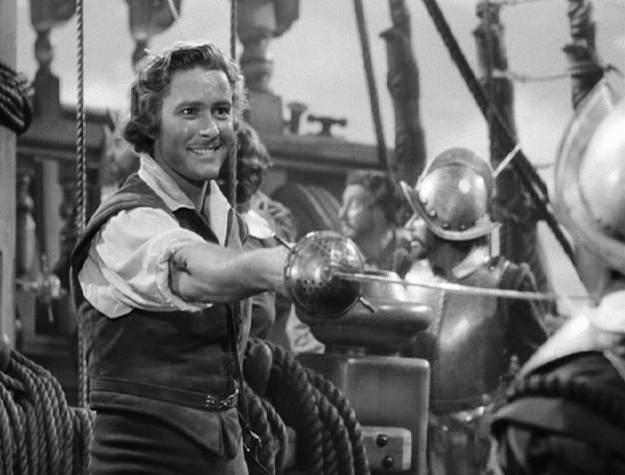
Probably no actor ever got luckier with a first starring role in the movies than Errol Flynn. At the age of 25, he was given the lead in Captain Blood on the basis of his looks, intense lobbying by some well-connected lady friends, and the fact that the film had no leading man and an imminent start date. At the time, Flynn’s experience amounted to a year of repertory theater in England and minuscule roles in about four B-movies. Raw-boned and gauche, he acquired authority and panache as filming went on, so much so that the first sections of the movie were re-done at the end of the shoot.

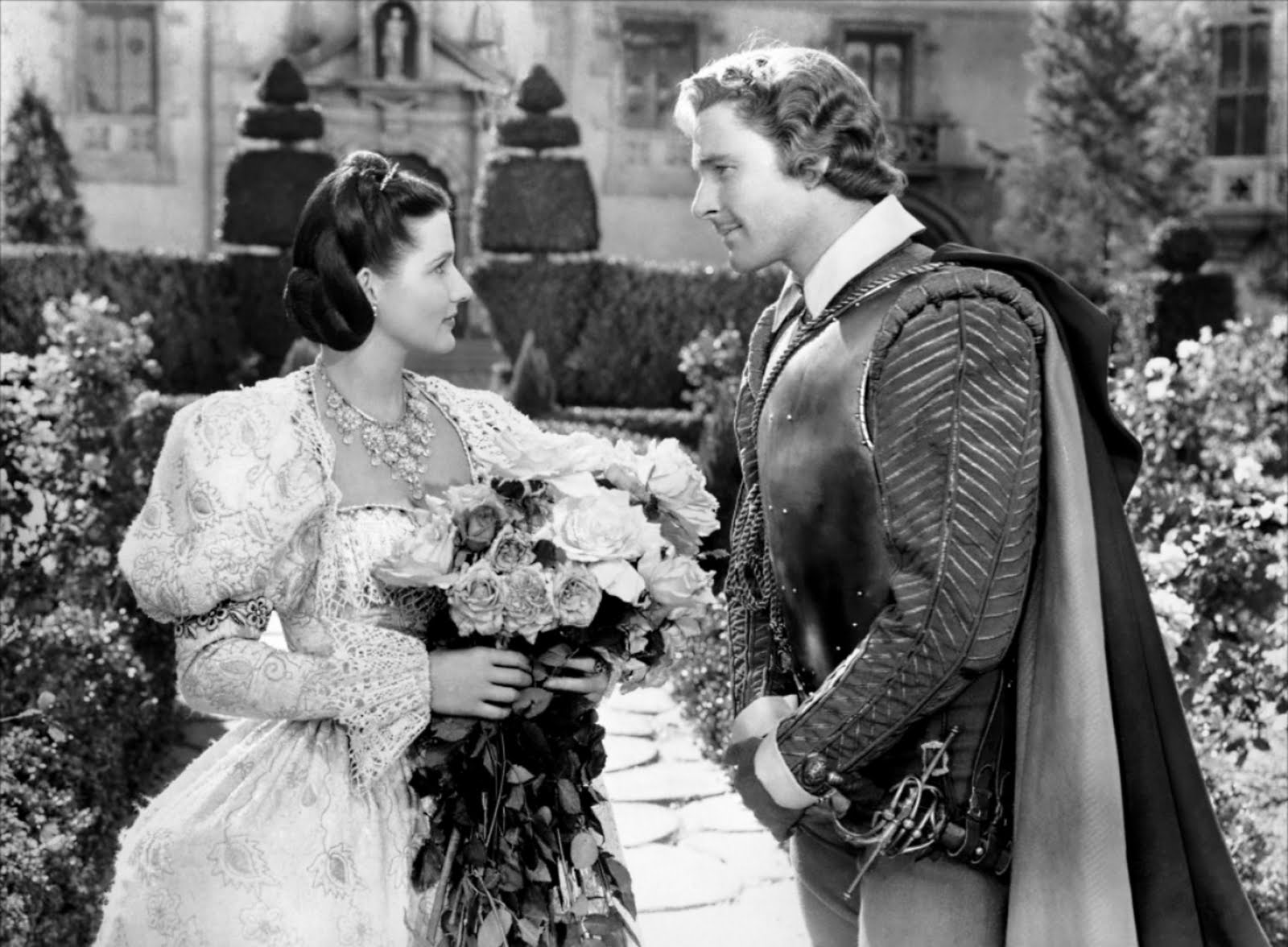
But what made Flynn lucky wasn’t just the opportunity. Captain Blood is still the greatest pirate movie ever made — thanks to clever, dynamic direction by Michael Curtiz, a stirring score by Erich Wolfgang Korngold, and a strong cast including villainous brigand Basil Rathbone and 19-year old leading lady Olivia de Havilland. De Havilland had as little experience as Flynn, but as Rathbone wrote almost 30 years later, “a more enchantingly beautiful young girl it would be impossible to imagine.”

A big hit, the movie was nominated for the best picture Oscar (it was beaten by the far inferior sea epic Mutiny on the Bounty) and made Flynn a huge star overnight. More than that, it established a template that Warner Bros. followed, more or less, for the next couple of decades. Flynn made 12 movies with Curtiz, seven with Korngold, three with Rathbone, and eight with De Havilland. But as fate would have it, he made only one more swashbuckling pirate movie for Warners: The Sea Hawk, which debuted 70 years ago today.


Among movie buffs and Flynn fans, The Sea Hawk is highly regarded. There’s a lot to like about it: Flynn, here at the peak of his career, has far more acting authority than he’d had in Captain Blood; Curtiz and Korngold are back with their typically first-rate work; and Warners poured almost $2 million into the production at a time when a movie could gross half that amount and be a hit. In fact, the studio built a huge new soundstage and tank just for this film, as well as two full-scale sailing ships that were moved by hydraulics. The movie also re-purposed huge, vaulting sets and beautiful costumes from the previous year’s Flynn vehicle, The Private Lives of Elizabeth and Essex.

But as good as it is, The Sea Hawk doesn’t quite make it onto the list of truly magical movies. The cast and crew are in there pitching, and everyone does a professional, workmanlike job. Swords clash, sea shanties are sung, hordes of sailors swarm over the riggings, dark deeds are plotted in castles, galley slaves mount an escape…and yet you don’t particularly care about any of it. The reasons, I suppose, lie in the script and a couple of crucial casting mistakes.

Captain Blood was based on a novel by Rafael Sabatini and had a literary and beautifully structured screenplay by Casey Robinson. The Sea Hawk was ostensibly based on another Sabatini novel, but in fact used only the title. The original screenplay was by Seton I. Miller and in fact had a different title — Sabatini’s was used as audience bait (his name still meant something in 1940) and because, well, it’s a great title.

Miller’s screenplay was rewritten and sharpened by Howard Koch, a fine writer who had an instinct for how to punch up scenes with intelligent, ironic dialogue. Koch had the idea to make the story more timely by turning it into a metaphor for real-life events — England was already at war with Nazi Germany, and in the two years before the U.S. joined them, there was a widespread effort at solidarity and support in Hollywood. Koch’s angle was to turn Phillip of Spain into a Hitler intent on conquering the world, and Queen Elizabeth into a Chamberlain who attempts appeasement and then a Churchill who fights back openly.
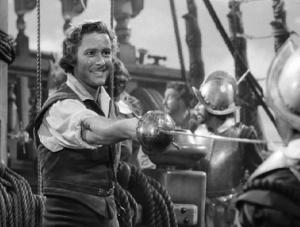
Flynn’s character, Geoffrey Thorpe, is a gentlemanly sea captain who turns pirate in order to covertly serve the Queen and her political needs. Thorpe isn’t a great character like Peter Blood, a foppish doctor sold into slavery who becomes a pirate out of outrage and a desire for revenge — Thorpe is more like one of the anonymous G-men from innumerable Warners pictures of the era. While that may have satisfied the politics and censorship demands of 1940, it robs the movie of some fun…these are the cleanest and most morally upright pirates you’ve ever seen. Flynn, who wanted to be a serious actor and resented swashbuckling roles, plays the role in a restrained and almost dignified way, and you wonder why the inevitable haughty wench on board (the Spanish ambassador’s niece) doesn’t see what a great guy he is right away.
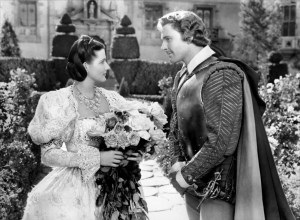
The haughty wench is a problem, too. Maureen O’Hara perfected this part in the 40s; it’s too bad she didn’t meet up with Flynn until 1952, when his lifestyle had begun to seriously erode his enthusiasm. Here, the wench is played by Brenda Marshall. Who? Exactly. This movie was Marshall’s big chance, and it must be said that she muffs it. Her acting is wooden and totally conventional, her face a mask of pouting unhappiness that seems more related to her own personality than to the role. Marshall can’t even make you smile at a line like “Uncle, my jewels!” as her bedchamber is invaded by pirates.

Where’s Olivia de Havilland? At the time, she was fighting Warners for respect and better roles, and wanted something more than to be Flynn’s leading lady. She only played with him a couple more times before going on to prestige movies and a couple of Academy Awards. In her old age she seems to have realized, like Ginger Rogers and Myrna Loy, that her romantic partnership onscreen is her greatest claim to immortality. De Havilland and Flynn had a beautiful rapport as actors — his rashness and boldness seem to excite and offend her at the same time, which is quite funny; her gentle sweetness brings out a sensitivity in Flynn that almost seems to surprise him. “I really believe that he was deeply in love with her,” commented their co-star Bette Davis, and the feeling was very evidently mutual.

Marshall and Flynn, in contrast, have zero chemistry. And so you’re left to ponder the rote quality of so many old movie romances: hidden attraction, conflict, cleared-up misunderstandings and declarations of love, separation, longing and heartbreak, reconciliation, kiss, fade-out. The situation isn’t lost on Curtiz, who resorts to director’s tricks to make this non-romance come alive. When the two are parted, he alternates shots of them looking longingly into the distance as Flynn sails away — the movie seems to be shouting “LOOK, THEY’RE IN LOVE WITH EACH OTHER!!!”

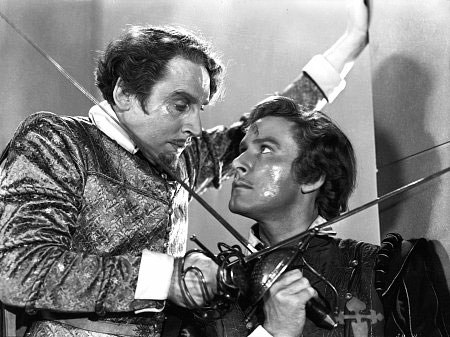
The villains aren’t much better. Claude Rains returns from Flynn’s Adventures of Robin Hood, but he has no memorable lines and lets his evil haircut and facial hair do his acting for him. In Captain Blood, Lionel Atwill played basically the same role and gave it dark hints of sexual obsession and sadism (OK, maybe it wasn’t too much of a stretch for him). Rains just coasts here. In Robin Hood, he was beautifully paired with Rathbone, who played the fiery man of action to his sly rascal. Here, the Rathbone role is filled by Henry Daniell, and that’s a pale carbon copy. Flynn’s chemistry with Rathbone was as magical as his rapport with de Havilland — they had the same energy level, and when they hurled challenges and insults at each other, you felt an underlying respect and affection. At some very elevated level, they were playacting, and every scene they shared crackles with exuberant antagonism.
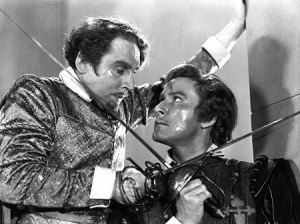
Daniell, on the other hand, apparently was the cold fish he always played, and as an actor he had only one note of sneering superiority. And in fatal contrast to Rathbone, the best fencer in the business, he couldn’t handle a sword. A studio memo from the middle of production reported that “Mr. Daniell is absolutely helpless and his closeup in the duel will be mostly from the elbows up.” As in all Flynn swashbucklers, the climax is supposed to be the big duel to the death, but Daniell seems to barely be in the scene. As with the romance, Curtiz is forced to use director’s tricks to make it come off. Longshots, doubles, heavy shadows, furious cutting. Workmanlike, but unmagical.

Many commentators on The Sea Hawk have also noted the absence of Technicolor, but the movie does have strong black and white photography. This was an economic decision which allowed Warners to re-use battle shots from Captain Blood and a couple of other older epics…It also allows for a nice effect during the movie’s best sequence: a trap laid for Flynn and his men in the jungles of Panama. Sepia gives this sequence a real feeling for the heat of the swamps and the misery that our heroes endure, and it helps break up the movie as well — at more than two hours, it’s rather a long journey. Finally, England is once again purged of treason; the lovers are reunited, the trumpets flare, and the Warners’ shield announces The End. You’re left admiring the craftsmanship that went into mounting this sea epic on a soundstage, but you haven’t ever really sailed away.


Originally published on Edward Copeland on Film.

The White Album

Beatles-The-White-Album

One of the best events in Orlando is “Classic Albums Live.” This is a concert series where they play a single classic rock album all the way through, note for note and word for word. It’s often like meeting an old friend, in that the totally familiar rubs up against the new and strange. Also, no matter what the album, having it performed live opens it up to a third dimension… you kind of walk into the record and poke around in it, making discoveries.

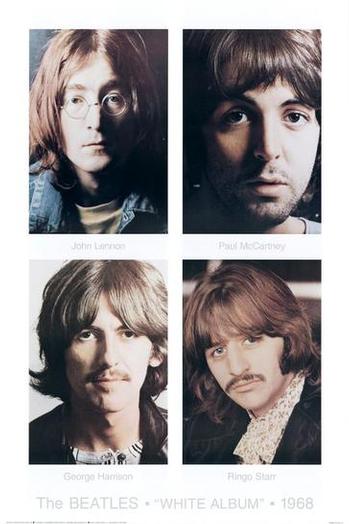
The one I looked forward to most was The White Album, which has always been a favorite record of mine. For one thing, it’s just got a lot of songs, and more Beatles is better, right? Um, right? More to the point, the group was more fragmented personally than at any other time, and the contrasts and dissonances make it an edgy, almost uncomfortable listening experience. One song will assault you, the next will soothe you, over and over. It’s the only record on which the Beatles weren’t trying to be cheery, upbeat lads. Or even a band, in the old sense. The seams are showing.

At the concert itself, the man behind me was offering his friends a garbled, inaccurate version of the album’s history, especially the influence it had on the Tate-LaBianca murders. And indeed Charlie Manson is a presence… not just in Helter Skelter and Piggies, but in the whole gestalt of the record (did I really just use the word gestalt? Sorry….). I was only a kid in 1968, but young as I was I recall the bad vibe of that year — the cities on fire, the assassinations (there seemed to be dozens), the war and the war protests leading the evening news every night. The holiday dinners when my “greatest generation” dad, uncle and grandfather would come back from hunting to rant about the goddamn hippies and their long sissy hair. Thanks, Grandpa — can you pass the plate of doves you just shot?

None of this came back at the concert, though. Time has passed; we have new atrocities on the news, and a new soundtrack for them. At the live concert experience, I just noticed many awesome moments: the guitar solos on While My Guitar Gently Weeps, the shredding vocals on Why Don’t We Do It in the Road?, the haunting beauty of I Will and Julia, the despair of Yer Blues and I’m So Tired, the soured rinkydink of Rocky Raccoon and Honey Pie. The profusion of sounds and styles. Lennon’s brutal honesty and McCartney’s evasive cleverness. The sheer authority of every song, even piddling little nothing songs. It’s like a cathedral, the White Album — but a deserted, haunted cathedral with rats scuttling in the corners. Enter at your own risk.

I Have Sold Your Facebook Data

I suppose you’ll call this a confession. But that would imply some kind of remorse, and I have to say, I feel pretty good. Probably the money helps.

No, it’s because we’re friends — Facebook friends, and you’ll agree with me that’s a pretty elastic term — that I feel I owe you full disclosure. So here goes: I have sold your personal data to a variety of extremely interested and apparently deep-pocketed marketing firms.

Look, it’s a trend. And all my life, I’ve gotten into these things too late. The dot-com frenzy, remember that? I invested in my first startup in late 2001. Cautious, I guess. Well not this time. There are lots of people out there who want to know about you, my Facebook friends. How many Twilight books you’ve read, or about the interesting fact that you’re Jewish but also a Tea Partier, or that you recently joined a drum circle. And let’s just be honest. If I don’t tell them, someone else is going to do it and cash in bigtime.

Some of you are much younger than me. I see that you have over a thousand friends, and it makes me shake my head. Here’s one thing I’ve learned: in this life, you’re lucky if you can count the people who really love you on one hand. There might be a few dozen others who find you quirky, or pleasant company, or whatever. Then there’s your family and your in-laws, who are such an important part of your life, whether you like it or not.

These are the people who are really valuable, who really mean something. Why? Because you know so much more about them. What they like to eat, and read, and watch. Where they like to go out for drinks, or take vacations. Who they hang out with, do business with, vote for. Maybe even who they sleep with. These people are a goldmine… literally.

But of course now thanks to Facebook, everyone has a value. Some less than others, of course. I’m finding that there isn’t so much demand for the personal information of my better-known friends, like Apolo Ohno and the Dalai Lama. Tapped out, I guess. But you, Cute High School Girl Who Wouldn’t Give Me the Time of Day 30 Years Ago, But Now Wants to Flirt Online… bring it on, baby. Because I see you like to collect Hummels and you’re knitting another sweater. And I find that means a lot to me.

But Eddie, what about my privacy, you’re probably thinking. Well, snap out of it, because there’s no such thing anymore. Computers are recording every transaction you make and every online conversation you have, the phone company is recording your every call and text, cameras are recording every move you make outside your house. Take comfort in the fact that amid all those huge reams of data, you’re actually kind of anonymous unless you do something unusual or interesting. And again, addressing my younger friends, you’ll find yourself doing fewer and fewer of those as time goes by anyway.

One last thing. I guess it’s only fair that you should be able to market my information too. I’ve adjusted my “privacy settings” accordingly, but if you want a quick summary, I’m in my early 50s, have a college degree, purchase top-shelf liquor, collect classic movies on DVD and donate to film preservation, enjoy yoga and meditation, have recently gotten into gardening — and after a few slow years, my personal income is rising again. But then you already knew that last part.

Walking Meditation

walking med

This morning, we did something different in meditation class: a walking meditation. About 20 of us went across the street to the park, our teacher Jamie struck a chime on his singing bowl, and we were off.

I shut my eyes and started out. At first, I couldn’t get the self-conscious grin off my face, thinking how silly I must look to the passing cars and pedestrians. But then I stopped thinking and began to focus – partly because I had to.

With my eyes closed, each step was an adventure. Lift the leg… bring it forward… wobble slightly on the other… put the leg down. At one point, the ground wasn’t where I expected it to be and I fell forward slightly. Ah, expectations… valuable lesson there. Stop thinking. Back to mindfulness. One step at a time, with full curiosity about each subsequent step. So different when you remove your ego with its endless expectations.

There were big trees in the park, and I worried I might walk smack into one. But as I focused closely on each step, I could feel the ground changing under me. Some slight softening of the earth, coupled with an incline, signaled that I was nearing a tree. Something would tell me to stop and I’d open my eyes slightly and I’d see a tree either in front of me or next to me.

We did this for 25 minutes, but it seemed like a matter of seconds. I could have done it all day. It was the best meditation I’ve had yet — a powerful demonstration of the benefits of staying firmly in the present moment and paying rapt attention to it. We are, after all, walking through a park with our eyes closed… if only we knew it.

Humble Warrior

humble


You stand with one leg in front, bent; the other stretched behind you. A deep bow at the waist, head down, with hands interlocked and arms stretched high behind and above you. It takes enormous strength and balance, put in the service of humility, devotion, receiving. It’s a yoga pose called humble warrior.

It’s also an attitude.

In Living in the Light, Shakti Gawain explains how we all have male and female energy within us. The “male” energy is our ego: our ability to take action in this world. The “female” energy is our intuition: our inner guidance that feels like it comes from some higher power; it certainly knows way more than our ego does, and often we don’t know how it knows what it knows. But it’s always right.

To understand this, you have to put aside your socialized views of men and women, of GI Joe and Barbie, and however you feel about that. This is about energy, not gender.

The proper synergistic relationship between our inner male and female, Shakti says, is when our inner female says “I want that” and our inner male says “Great! I’ll get it for you.”

In so many people, what you see is the ego running wild and deciding everything, with the intuition a lonely, unheard voice in the background. An inner male dominating and subjugating, or simply ignoring, an inner female. And of course, there are plenty of demonstrations of this in the physical world: men or women who are aggressive, pushy, narcissistic, domineering, etc.

Or the reverse: often you see people with a strong inner sense but limited ability to take action. The sweet, kind people who can never seem to get their career going, to get over their illnesses, to make any money, or get ahead with their lives. The beautiful losers. And while often they’re superficially attractive people, they do a lot of damage through their inability to take a stand, draw clear boundaries, fend for themselves, or manifest their actual agenda in the world. Often these spiritual people turn away from the world entirely, which is emphatically not what the world needs. Often they tell themselves they’re taking the high road by not taking the action they know they should be taking, when really it’s helplessness. Turning away from a fight isn’t a moral decision if you’re actually unable to fight. People like this are manifesting a strong inner female but a weak inner male.

You can see this playing out in relationships: one partner sets the agenda, makes the decisions, “wears the pants” so to speak. The other is the supportive homemaker, the nurturer. At worst, these relationships can become abusive and toxic; think about the Me Too movement. But even when the partners stay relatively balanced and harmonious, sooner or later the moment comes when one gets fed up and says: “why can’t you ever…?” because conflict arises over this fundamental difference. The problem is that in the long run you can’t simply outsource to job of your inner male or your inner female, whichever one you can’t actualize yourself, to a partner.

On a more public scale, you can see this manifesting in the Republican and Democratic parties. Republicans usually think they can “go it alone,” that they’re self-made, that people needing help are whiners, that might makes right. Often, their ignorance is shocking. They know how to use power, but their use of it is mindless at best and monstrous at worst. Ego is the whole show. Democrats are about inclusion, “fairness,” helping the needy, leveling the playing field (which often rightfully enrages Republicans who earned their money and don’t want it taken away and given to people who didn’t). Democrats’ values are great but they usually don’t know how to fight effectively and often their solutions are unrealistic and idealistic to the point of absurdity. And as often happens on the individual level with intuition and ego, they only get a chance to prevail when the other side (the ego) crashes and burns through its corruption and blindness. On the political level, ego and intuition hate each other’s guts, and yet they need each other. It’s the same as with relationships. They’re actually two critical parts of the same system… if only they knew how to work together.

So the answer starts on the personal level. What we want to have is a healthy and confident ego that knows how to make things happen in the world…  but 100% in service to, and in support of, a clear and fully realized intuition. This is the proper role of both energies, developed and encouraged to be equally strong inside of every individual. This should be the goal of real spiritual practice: not turning away from the world, but engaging with it mindfully. Fearless and focused action based on steady wisdom.

In other words, humble warrior.

Random Thoughts on Hamlet

Saturday, we went to see Hamlet at the Orlando Shakespeare Theatre. Nicely staged, some good performances, but as so often with Shakespeare, I found myself listening past the actors to the words.

When you read annotations of WS, you discover that there are layers and layers of lost meaning: puns, allusions, references that are so packed into every line you get dizzy. Yet even without catching half of what he’s saying, he’s still a riveting dramatist because he gets at primal emotional dilemmas: the intersections of love, betrayal, trust, ingratitude, selfishness, idealism, ambition. Even a callow actor like the kid playing Hamlet was able to put across the character’s shrewd intelligence, his confusion and vulnerability, and his impotent rage.

Maybe it’s impossible to fully act Shakespeare, at least a whole play. When you see an actor really connect with the part and put all the meanings across, it’s a thrilling experience. Brando standing on the steps eulogizing Caesar, his passion bursting through his finely chosen ironic words… Basil Rathbone as Tybalt, sneering at Romeo as his challenges go unanswered (he practically mouthes the word “pussy”)… Olivier staring at the camera and forcing you to identify and empathize with Richard’s bitter self-justifications… Howard Keel’s strutting, vain, hilariously overconfident Petruchio realizing he isn’t nearly the badass he thinks he is.

One of the best biographies I’ve ever read is Michael Morrison’s “John Barrymore, Shakespearean Actor.” Using various sources he meticulously recreates Barrymore’s legendary 1922 performance of Hamlet, taking you through the entire play so vividly that you feel you’re sitting in the front row watching it. Miraculous writing. This was the first production to take Shakespeare out of the old declamatory tradition and ground the play in modern psychological meaning. Stylized minimal sets, simple costumes. The operating principle was that this was a brand-new play no one had ever seen.

What people loved most about the performance was that Barrymore played Hamlet as a Prince — noble, proud, charismatic. That aspect was completely missing the other night: the kid played Hamlet more like Adam Lambert having a sustained snit (maybe I’m getting more crochety as I get older).

Yet, listening through to the words, I felt in some ways I was seeing a brand new play, or at least seeing it through new eyes. For the first time, I felt intense compassion for this idealistic, smart but fatally innocent young man reacting a few beats too late to the careless treachery of the older people around him. I know this kid, I thought. I am Hamlet. But I’m also way too much like Polonius for comfort, and I discovered that I have more than a bit of Claudius in me too.

If the purpose of playing is to hold a mirror up to nature, then wow… ouch.

Help!

Just re-watched the film of the same name, starring the Beatles back in 65, at the height of Beatlemania.

“We were extras in our own movie,” complained Lennon a few years later, and he wasn’t far wrong. There are long tedious stretches of faux-Indian faux humor featuring Leo McKern, who would have to place high on any list of the world’s most repellent and unfunny comedians. And too often the Beatles just cavort meaninglessly in the snow or the surf or the countryside, as anonymous as stop-motion puppets.

Still in the edges it’s a fresh and relevant movie. The director, Richard Lester, was trying to turn the four of them into modern Marx Brothers, and while he pretty much failed, it’s amazing how close Lennon came to being like Groucho. When he looks at the camera and waggles his eyebrows, he makes the same kind of connection with the audience — the smart guy who isn’t taken in, who knows bullshit when he sees it, who rolls his eyes scornfully at piousness and cliche. Just like Groucho, Lennon cuts through the intervening decades and is right here with us now.

Ringo makes a connection, too — he’s a lovable doofus, and a great camera subject. There’s a musical number where he’s playing drums with a cigarette dangling from his lips, and he’s just effortlessly cool. The movie is built around him and his rings, and despite the corny cutups he comes through with his dignity intact, and the same kind of wry sweetness he had 25 years later guesting on The Simpsons.

George and Paul don’t fare so well. George was 22, and while he too was effortlessly cool, he doesn’t have a lot of personality… and clearly the writers and director couldn’t care less about him. As for Paul, he’s a great artist but his busy Gemini brain always makes him look twitchy, phony and cold on camera. He can’t cross his legs without seeming calculating and manipulative. However, even half a century later, you can almost hear the little girls screaming over his handsome little piggy face.

There are glimpses of swinging London, too, and they remind you that once upon a time, there was art and excitement happening somewhere. Change was in the air, and every one of the songs seems to be announcing it. Every ringing chord seems like a rebuke to this empty age we’re living in now. Help — I need somebody! Not just anybody…

All these years later, I know just what you mean, Johnny.

Going Back

9-11

“There were many words that you could not stand to hear and finally only the names of places had dignity. Certain numbers were the same way and certain dates and these with the names of the places were all you could say and have them mean anything. Abstract words such as glory, honor, courage, or hallow were obscene beside them.” – Ernest Hemingway, A Farewell to Arms

When they reopened my office in lower Manhattan on Tuesday, September 18, 2001, I rode back into the city on my usual morning bus. All through the Lincoln Tunnel, a mile and a half under the Hudson, I gripped the armrests with white knuckles, certain that a bomb was going to go off. Nothing happened, just like nothing had happened during the previous week when I’d awaken in the middle of the night weeping, sweating, terrified. Then I’d check each window and door of our three-story house in the Jersey suburbs, making sure they were bolted. No terrorists out there. Back to bed, but not to sleep.

So after an eternity I made it through the tunnel, out of the bus station, up the escalator to the corner of 40th and 8th. At the entrance to Port Authority, on every wall, pillar, window, column were little 8½ x 11 posters. Each one was homemade, and said much the same thing: have you seen this person? The name, the family’s contact information, and a big picture of someone. Happy pictures of people on vacation, or at a birthday party. In those early confused days, some held onto the belief that missing relatives might be in local hospitals, disoriented or unconscious. Suddenly seeing those hundreds of smiling faces, and their little messages of love and grief, like candles held out to me in outstretched palms, the pain almost felled me to my knees. I felt stunned, like a man who’s been punched in the stomach. I stood there for a long time with them all watching me, not turning away, just feeling it.

The subway ride downtown. The World Trade Center had been a major transportation hub, and with it gone, there were fewer trains. What trains there were in service were all half empty this morning. Now normally on the train, people bury themselves in the paper or their iPods or sit with their eyes shut. You learn to avoid eye contact in a big city; it’s safer. But this morning, and for several days after, everyone looked right at you. Not just at you but into you, the way a lover looks into you sometimes, with a probing, delicate curiosity and defenselessness. A look you might flinch from, especially from a stranger. But our egos had crumbled to rubble and now we knew that looking away wasn’t going to make us any safer. Far, far from it. We had nothing left to hide from each other. Our faces all spoke the same holy, unspeakable thing.

Out of the subway and up the stairs to downtown, where everything was as silent and white as after a snowfall. Every surface still covered with the ashes of the World Trade Center. No color anywhere, it seemed — only the green camouflage of the soldiers who stood on every corner of the twisted little streets of lower Manhattan. The soldiers were all young men, huge GI Joe types with hulking V-shaped torsos and biceps like hams. God knows where they’d been shipped in from; nothing like that grows in New York. Their faces, at least, were not open. Each stood stock-still and expressionless at a wooden barricade with a huge semiautomatic weapon strapped over his shoulders. On guard just like I had been at my house, against a threat that wasn’t coming anymore because the most terrible thing that could happen already had.

The other thing about downtown was the smell. A week earlier, it hadn’t been so bad. Running to the water, I had given the rag that was covering my face to someone else, so I had breathed in the smoke and ash—but I didn’t recall anything like this. A burning smell, but not a sweet burning smell. A big white-noise charnel house smell that entered not just your nostrils but your pores. In it you could detect traces of plastic, rubber, wood, metal, and maybe something else. It’s the worst odor you can imagine, and if there’s a Hell, that’s how it smells. An elegantly dressed woman on the street next to me cried out something wordlessly about it… a sound I’ve never heard before or since. An animal moan of revulsion and sadness and protest.

Later, people put flowers and other memorials on the sidewalks, but for now there were just a few signs in windows: little makeshift printouts of flags, or pictures of the towers with the date. As if to just say “we were here,” the way miners trapped in a shaft might scrawl it on a wall. The merchandising hadn’t begun, nor the bickering over what to build at Ground Zero, nor the lies about how the air was perfectly safe to breathe—only the first of so many lies. In the blasted silence of downtown, with the smoke still belching from its enormous wound, there was only a terrible, stricken kind of humility and awe that had its own special… what?

Beauty, I guess.

The beauty of finally seeing, and knowing, the worst.

Photo of Ground Zero by Eddie Selover, September 2001.

Seven Factors, Five Hindrances

From the Buddhist who led my meditation class this morning:

7 Factors of Enlightenment

* Mindfulness: to be aware and mindful in all activities and movements both physical and mental
* Joy or rapture
* Investigation into the universal laws of nature
* Concentration
* Relaxation or tranquility of both body and mind
* Energy
* Equanimity: to be able to face life in all its vicissitudes with calm of mind and tranquility, without disturbance

5 Hindrances to Enlightenment

In Buddhism, the five hindrances are negative mental states that impede success with meditation and lead away from enlightenment.

* Sensual desire: Craving for pleasure to the senses
* Anger or ill-will: Feelings of malice directed toward others
* Sloth, torpor or boredom: Half-hearted action with little or no concentration
* Restlessness or worry: The inability to calm the mind
* Doubt: Lack of conviction or trust