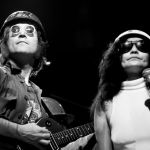
When John Lennon released the album “Some Time in New York City” in 1972, it was widely considered the nadir of his career. Indeed, almost a deliberate torching of his career, what with the naive, cliched radical-chic lyrics (“it ain’t fair, John Sinclair, in the stir for breathing air / free John now, if we can, from the clutches of The Man”) and the sharing of vocals with his wife, Yoko Ono. Her screeching and warbling took the deliberate provocation of the protest songs to another level of sonic assault and (occasionally) aesthetic offensiveness.
The album was a massive flop, commercially and critically, and no doubt its blistering reception helped precipitate the Lennons’ subsequent separation. On these songs, Lennon sounds massively self-confident, but it’s the self confidence of a man who has known nothing but success since his late teens (a decade, basically) and is now rich, famous, and surrounded by sycophants and hangers-on. Sadly, Lennon would never recover that confidence; on his subsequent albums he’s a whipped dog compared to the man celebrating life in “New York City” (the album’s best track).
The Lennons’ son Sean did a smart thing in assembling this new box set, which features two live shows at Madison Square Garden, plus demos, home recordings and other music from the period. The album itself gets lost in the shuffle, I assume deliberately, but it also gets contextualized. With a wider view of the couple’s activism, it appears less opportunistic and shallow than it did at the time. In 1972, John and Yoko looked like fools; now their commitment and even their naïveté appear kind of sweet. Also, the new mixes reveal the awesome musicianship underpinning the songs—too bad Sean didn’t do a disk with the vocals removed, because musically it all rocks, and there are several gorgeous melodies (“Angela,” “The Luck of the Irish,” “Now or Never”).
There’s been controversy about Sean and his team removing the album’s first track, and its only single: “Woman is the Ni**er of the World,” due to the title. I’m personally not a fan of that kind of historical revisionism, and so many other objectionable words and phrases survive that it seems like overkill. “WITNOTW” was an attempt at a feminist statement that Lennon later disowned as shallow and unfelt, but like much of this music, the sentiments are valid. The execution was the problem.
Lennon’s concept was to just dash the songs off, like bulletins from the forefront of the Left’s struggle with “the Man,” and that accounts for the lyrics being mostly repetitive and half-baked… that, and his wife’s inability to improve his writing the way Paul McCartney had. On the other hand, Lennon’s vocals and his playing are fantastic—he soars as a musician even as he faceplants as a “thinker” or a serious political figure.
There’s another issue with this music, one that doesn’t get discussed much: as with “Double Fantasy” the basic trouble is that John and Yoko’s styles don’t mesh. I say this as someone who actually likes Yoko—she’s written many beautiful songs, and is often very powerful and moving. She has a feminine perspective and doesn’t apologize for it; her fierceness is refreshing, and her goofy flower-child thing is kind of endearing. Her album “Season of Glass” moved me very deeply and even changed me; it’s better than any single Lennon album. But whatever Ono’s personal chemistry with her husband, she didn’t have artistic or musical chemistry with him.
Many people have concluded that this was due to a disparity of talent, but it’s more that her talent is spiky and experimental and purposefully askew… I can’t imagine anyone collaborating successfully with her. Lennon added almost nothing to her work (except his awesome guitar on “Walking on Thin Ice”). As for her effect on him, he mostly used her avant-garde performance art to give himself permission to display the less attractive sides of his talent: the self-indulgence, the smug hectoring, the facile laziness, the unpleasant soul-baring, and of course the primal screaming.
All this might sound like I’m slamming this set, and really I’m not. It revisits a seriously flawed album and makes it listenable—even understandable and sympathetic. Musically it achieves the amazing feat of being not bad at all. And historically, it shows a famous couple gambling everything on their own celebrity… and going down in flames, gloriously. The balls-to-the-wall honesty and fearlessness of it had the perverse effect of increasing my affection for both of them.
 Eddie Selover