Dream Eddie

dreaming

Yesterday, two friends told me about dreams they’d just had about me, dreams that disturbed them a little bit.

The first was set in an office. I was brusque with my friend in the waiting room, it seems, and then I went into my office and was shouting abuse at him through the door. Then I came out and threw a boxcutter at him, like it was a ninja throwing star. It hit him in the chest and lodged there. Yikes. Guess this is what happens when you don’t have an appointment, Dude.

In the second dream, I was in a hotel with my other friend. I was boiling with agitation and drove him away, fast and furious, to show him a house I said I’d been building my whole life. This was a big one-story magnificent glass house, very zen-like and empty of furniture. Once I was there, I was very happy and confident and I adamantly refused to go back to the hotel. My friend wanted to go back and I told him I wouldn’t take him there, and to go get a cab. I laughed at his description of me: “relaxed and peaceful but with a dose of Clint Eastwood.”

So what can we learn here, aside from the obvious fact that two of my closest friends see me as a bit of a dick?

Or is that the lesson?

My wife, who’s a therapist, has told me that in dreams, all the characters are us. Or some aspect of us. Maybe that lets me off the hook, yet I can’t escape feeling a little guilty. It’s strange when somebody tells you, with great intensity, how you acted in their dream. They recount it as if you’d really done it, and it’s like being told you did or said something when you were drunk.

Is there a Dream Eddie? Does he go out when I’m asleep and commit these and perhaps other, possibly much worse, acts?

Or is there some sort of Energetic Eddie? Just as there might be choppy waves in the water after I’ve jumped into the pool, do the things I say and do have an afterlife that impacts others?

Now we’re getting warmer.

Because I have been noticing this lately: how strong our impact can be. How much we can affect other people, and not just by our words and actions, but by our thoughts. You can sit there in judgment and anger at another person, not even expressing it, and they can feel it. The same goes for loving and supportive thoughts. “Thoughts become things,” they say in The Secret, and that’s true, but it’s also true that thoughts ARE things. A thought has power, and a thought with emotion attached to it even more so.

For a long time, I did not believe this, or more accurately, I knew it somewhere but lied to myself about it, because I didn’t want to own it. I told myself that if I thought something but didn’t express it, it didn’t count.

Not true. We’re all fields of energy, and the vibrations that come off us are radiating out into the world and affecting things all the time. I can see it in my dog, for example, who responds like a tuning fork to whatever mood I’m in. I can see it in my co-workers, the movement toward or away from me depending on my own responses.

The reason I didn’t want to own this is that it’s a huge responsibility. Bad enough to have to own your words and deeds, but to have to own your vibrations? Scary.

But better to be aware of your impact, to take responsibility for it and direct it consciously, than to ignore it and give your friends nightmares.

Everybody Knows

???????????????????????????????????????????????????????

But all of a sudden I realized that he knew also, just like I knew. And that everybody in the bookstore knew, and that they were all hiding it! They all had the consciousness, it was like a great unconscious that was running between all of us that everybody was completely conscious, but that the fixed expressions that people have, the habitual expressions, the manners, the mode of talk, are all masks hiding this consciousness.

Passing money over the counter, wrapping books in bags and guarding the door, you know… all the millions of thoughts the people had… the complete death awareness that everybody has continuously with them all the time… all of a sudden revealed to me at once in the faces of the people, and they all looked like horrible grotesque masks… hiding the knowledge from each other. Having a habitual conduct and forms to prescribe, forms to fulfill. Roles to play.

But the main insight I had at that time was that everybody knew. Everybody knew completely everything. Knew completely everything in the terms that I was talking about.

—Allen Ginsberg, Paris Review interview, 1966


So there’s a story in today’s New York Times about a man who died recently in Poughkeepsie. He was found dead in his house at the age of 82. He had reported his wife missing 27 years earlier, and when they went through the house after his death… yeah, they found the wife’s body behind a wall in the basement.

Here’s the story:  http://www.nytimes.com/2013/07/16/nyregion/amid-junk-at-hoarders-house-his-missing-wife.html?hp&pagewanted=all

What was really interesting to me was that nobody believed the man’s story that his wife had just up and left him. Everyone, even people who knew nothing about him, found him creepy. They all knew. Not the exact details, maybe. But they knew something was wrong. If they’d allowed themselves to sit more deeply with the knowledge, I think they’d even have intuited that the guy was a murderer.

Why do I think that?

About 30 years ago, I read a very long interview with Allen Ginsberg in the Paris Review, and he talked about this same phenomenon. The heart of his quote is excerpted above.

Everybody knew. Everybody knew completely everything.

Reading this had a profound impact on me. Because I knew that yes, I knew too. And that Ginsberg was right: everybody else knew.

No need to lie. No point in lying. No point in trying to be something you’re not, or pretend something is true when it isn’t. Because we all know the truth. No point, even, in pretending you don’t know.

Reading and absorbing this really changed me. I dropped a lot of pretense and falseness. I began to trust myself and my own perceptions much more. I started speaking the truth as I saw it, without fear. I began to disregard and ignore other people’s attempts at falseness, the “masks” that Ginsberg talked about, and speak to them more directly.

It was liberating. Because of course, other people (most of them) responded in kind. It’s like The Emperor’s New Clothes… a fable illustrating how people pretend not to see what’s right in front of them due to fear or shame or social pressure, and then when someone speaks the obvious truth, the whole sham crumbles in an instant.

Because really, we all see so clearly. We know the truth. We may try to dodge and hide, but we know. We may not know what to do about it, how to feel about it, what will happen next after we admit it. But those things will all take care of themselves. In the meantime there’s nothing whatsoever to be gained by pretending to believe things we don’t believe.

So drop your mask. Believe your own intuition. Trust your own mind. Know what you know. And don’t worry about it. Because everybody knows.

Here’s the full text of Ginsberg’s interview, which is well worth your time: http://www.theparisreview.org/interviews/4389/the-art-of-poetry-no-8-allen-ginsberg

Mt. Vernon Inn to Close

RedFoxLounge403333

Very sad news in this morning’s Sentinel:

http://www.orlandosentinel.com/business/os-cfb-real-estate-0708-20130707,0,1142747.story

Maybe this was inevitable after Mark Wayne’s death last year. Mark and his wife Lorna Lambey were the mainstays of The Red Fox bar, performing lounge standards with huge gusto and enthusiasm. I spent many, many happy evenings there, singing along like some kind of idiot. Once I also saw Mark & Lorna (they seem to need that ampersand) in a special benefit performance at The Social, but it wasn’t the same. They only had the magic inside the Red Fox — a tiny little room with maybe 12 tables and a dingy and uniquely depressing bar. Like many I suppose, I originally went to mock, and stayed to cheer. It wasn’t a question of talent or taste… Mark and Lorna believed in what they were doing, and they loved doing it. You couldn’t help loving them back. RIP Mark… kisses Lorna wherever you are… and farewell to a little piece of Orlando heaven.

Breathing Room

la

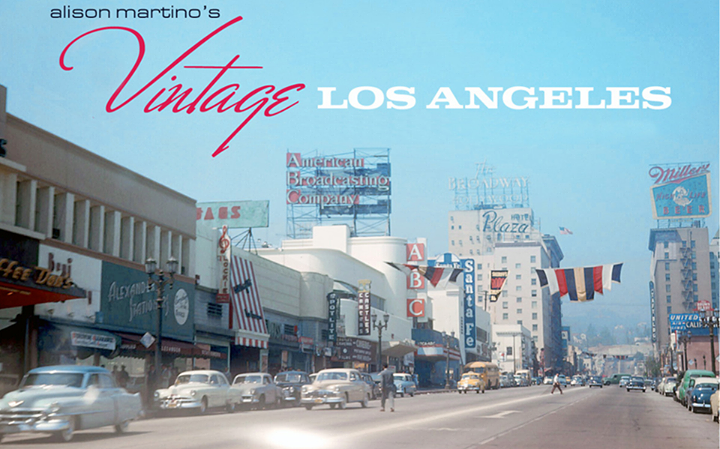
This morning I spent some time looking at photos of vintage Los Angeles.

Pretty intensely nostalgic, especially the 60s and 70s with their relatively empty streets and the space between the buildings. One of the reasons we left L.A. 20 years ago was because, starting sometime in the late 80s, the population doubled. The city I remember is long gone; it’s been overrun and obliterated by massive hordes of strangers. The L.A. in the pictures seemed to have some breathing room in it.

The good old days, right?

That’s one cliche; the other is: “it was a more innocent time.” Well though I was only a child, I remember the tail end of the 60s pretty clearly: the assassinations and scary violence, the crackling anger in the air. The intense green of the war in Vietnam on TV every night, juxtaposed with the dirty hippies protesting it and the old people snarling at them in turn. The shuddering way American life rent apart in a way that turned out to be permanent. Innocent is the last word to describe it.

And yet looking at those photos I see an innocence we didn’t know we had. It’s there in the pre-digital look of everything. The facial expression on a teenage boy looking at a hot rod speaks volumes about how much time and bare attention people seemed to have then, versus how frantic, self-absorbed, corporatized and impersonal life is now.

That’s the problem with nostalgia, though. The person who experienced it all, the person I was then, is also long gone. When I was ten years old, Van Nuys Boulevard was magical… it had a kiddie park next door to Ho Toys Chinese Restaurant. I mean: Chinese food! You went upstairs to eat, of all things. Paper lanterns, hot brown mustard, fortune cookies. Until around the time you turn 30, each new experience is an adventure, and you attach that sense of adventure to the people and places around you. Then you look back and it’s like a highlight reel: only the excitement remains.

I remember when I was 21 and traveling on my own for the first time, walking the streets of Berkeley sniffing the air for possibilities like a dog, dreaming of the girl I’d come hoping to see and feeling a glorious sense of freedom while I ate the only thing I could afford, a blueberry bagel. Forget the girl — that bagel is what I remember. It tasted like no bagel has ever tasted since.

I mentioned breathing room, but of course if I push my memory a bit harder, I remember what it was like breathing the Los Angeles air in the 70s… on some days, the smog was so bad that it rolled in like a bank of fog. There were days when you literally couldn’t see from one end of the high school quad to the other due to the thick brown haze. Before President Nixon, of all people, strengthened the Clean Air Act, the smog around L.A. could make your eyes burn and tear up, and you could feel it stirring in the bottom of your lungs when you took a deep breath. That’s the other problem with nostalgia: it only works when you carefully edit the facts or cook the books. Hell, you could even get nostalgic for Nixon.

And again that young man eating the bagel… would I go back and walk in his shoes again? He knew so little, about the world and about himself. Self-medicating, powerless, clueless… he was a mess. If you could have shown him the man I am now, the man he’d someday become, he’d have shit in his overalls. His little eyes would have bugged out of his head, and he’d have wanted to fast forward to get here.

No, it’s not my younger self I want to go back to, not California, not the 60s. It’s that feeling of having all the time in the world stretching ahead of me. It’s the sense of endless possibility.

Breathing room.

Too Much, Too Soon

flynn

A Great Profile

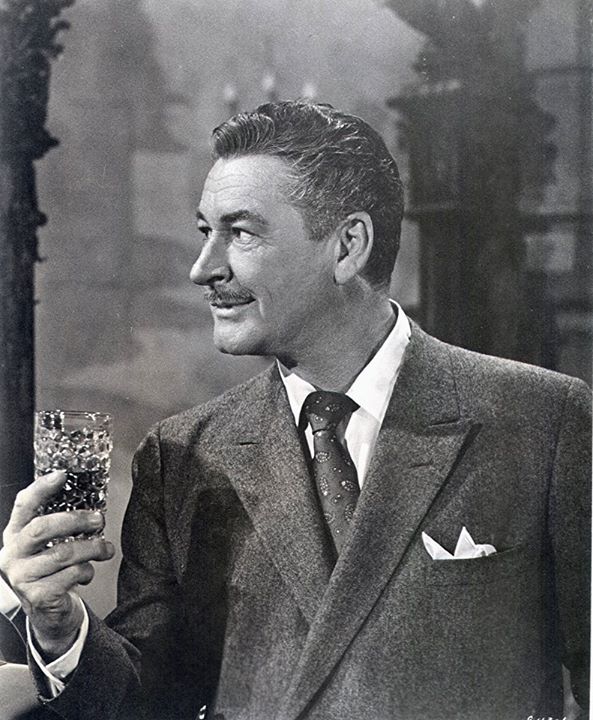
Too Much Too Soon  is one of the earliest examples of Hollywood eating its own. Lurid and sleazy, it’s like those cheap 50’s paperbacks that trashed famous people’s lives in the most obvious ways. Yet it remains fascinating, in a heartbreaking and horrifying way, because of its star: Errol Flynn.

Flynn had just come back from years in the wilderness — making one lousy European movie after another while drinking and drug addiction ate away at his self-confidence, his focus, and his looks. At the 11th hour, Darryl Zanuck rescued him by handing him the part of Mike Campbell, the dissipated wastrel in The Sun Also Rises. That excellent performance reawakened Hollywood’s interest in Flynn, and he was offered the part of his old drinking buddy John Barrymore in this bio of Barrymore’s daughter Diana (based on her own cheap paperback, also called Too Much Too Soon).

A soberer man might have rejected this exploitative little production, but at this stage of Flynn’s career, it was like being offered “Hamlet.” He even swallowed his actor’s vanity, allowing himself at age 49 to be cast as a man ten years older, and looking it (at one point in the film, he states his age, but only after a beautiful, telling little pause).

In fact, he wasn’t well cast. Barrymore was a hard, sharp, tough actor — a little guy who went for “big” stylized flourishes in his performances. As copious amounts of liquor gradually coarsened his skills, he descended into grotesque self-parody: waggling his eyebrows and bulging his eyes lasciviously at nothing, rolling his Rs and exaggerating his own cultured diction. Flynn evokes him, but not by behaving anything like him. Despite his swashbuckling reputation, Flynn was a sensitive, gentle performer with a gift of wry humor and rakish charm. His own alcoholism seemed to soften and diffuse his acting while at the same time giving him some inner freedom to finally externalize his rage, shame, bitterness and impotent longing. All of which he puts to effective use in this film, essentially creating a self-portrait with slight Barrymore echoes (the tilt of a hat brim, for example, or standing with body facing the camera but head held in profile).

Unfortunately, he does most of this without much help from the script. It’s a sort of dull soap-opera version of Sunset Boulevard, with the has-been Barrymore rattling around his mansion and his yacht longing for love, or something. In fact the best line in the movie was spoken by Flynn on the set, responding to instruction from the fourth rate, no-name director… drawing himself up, Flynn replied “Are you, Art Napoleon, telling me how to play a drunk?” There’s an unfair perception that Flynn played his final three roles, all of them alcoholics, the exact same way… that he was in fact not acting, but only playing himself. Not true. In The Sun Also Rises, his Mike Campbell is a superficially charming drifter continually being stung to anger by the evidence of his own impotence and irrelevance (and in acting terms, he holds several scenes together single-handedly). In The Roots of Heaven, he’s a cowardly military man tortured by guilt about his own weakness. In this movie, he plays Barrymore as he no doubt had observed him himself: as a broken man occasionally able to pull himself together and show his former stature, but crumbling slowly from the inside and painfully aware of it. Flynn’s uncompromising portrait of greatness in ruins is finally quite haunting, as he intended.

Halfway through the movie, Barrymore dies, and we’re supposed to remain interested in Dorothy Malone’s cartoonish, by-the-numbers Diana. But the movie dies along with Flynn, and there’s nothing left to watch but Ray Danton’s comically phallic tennis bum. Each successive scene is less interesting than the previous one, and Diana’s last-minute pullout from the tailspin of her life is the least convincing of all. In fact, Diana died a couple of years later, from an overdose of booze and pills, at 38.

As for Flynn, in real life he exercised his usual gift for snatching disaster from the jaws of success, using the filming as an opportunity to begin an affair with a girl on a neighboring set. She was Beverly Aadland, a 15 year old extra. Flynn had been tried for statutory rape in the 40s, an event which precipitated his downward spiral, but by this time he was living down to his reputation. After his death a year later, the girl’s mother Florence Aadland wrote (or rather, dictated) yet another sleazy paperback: The Big Love, the story of Errol and Beverly’s “romance,” and one of the craziest and most disturbing of all Hollywood memoirs.

In The Big Love, Flo describes the three of them attending a screening of Too Much Too Soon. Flynn was embarrassed to have revealed so much of himself, but also quietly proud of his work. As he should have been. Despite the fact that it’s a bad movie by any formal measure, it gets way under your skin thanks to his courageous and devastatingly sad performance. Despite everything around that performance being hollow — script, direction, acting — it still rings true.

Hitch

Christopher-Hitchens-007

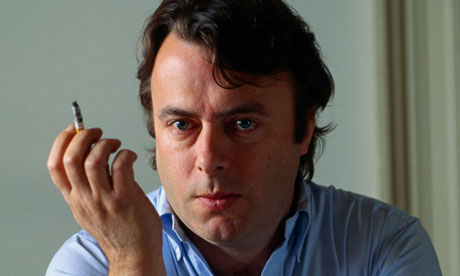
One thing I won’t say about Christopher Hitchens: RIP.

To a man as combative as he was, that would amount to a curse. Wherever he is now, he isn’t resting. And he wouldn’t want to be.

It’s all a guess where we go after this; he’d have said (in fact he did say, quite often) nowhere. I saw him make this point in person a couple of years ago, thanks to my friend Derek, who took me to see him at the University of Central Florida, debating the existence of God with Dinesh D’Souza. If there’s a more absurd topic to be debating, I can’t imagine it, but that ultimately didn’t matter. This was a show, and it was like watching a phlegmatic old bulldog facing down a yipping little terrier… the bone they were fighting over was much less interesting than the clash of style and personality.

Arriving at the stadium that night, I noticed a large number of buses in the parking lot. They were from local megachurches — the faithful had come, it seemed, to provide a cheering section for D’Souza. Or for God, I suppose in case He happened to be behind at half time. They filled the stands, row after row of earnest white people in sweaters, and at first I was a little nervous for Hitch.

I needn’t have been. The evangelicals were polite to him — they cheered and applauded whenever D’Souza made a point, but they listened to Hitchens thoughtfully and without making rude sounds. For my own part, I disagreed with everything Hitchens was saying, probably as strongly as they did. I’m no atheist. But this wasn’t a man you would dream of heckling. He didn’t mind standing in front of hundreds of people and calmly asserting they were full of shit. In fact, he obviously relished it. Hitchens had an intellect as sharp as a rapier, but he wielded it like a baseball bat.

Dogmatic, arrogant, intolerant, opinionated, often plain wrong and insistent about it. And yet, it was impossible to hate him, or even dislike him. You had to respect his intelligence and his eloquence, but it wasn’t just respect he inspired. He was lovable. He wore his vices beautifully, for one thing: he was an unapologetic smoker, drinker, and  hellraiser. His opinions, even the most provocative ones, were rooted in principles: honesty, freedom, fairness, honor. He may not have been at peace with the world, particularly its fools and scoundrels, but he was at peace with himself. He had a sense of humor, and it was large, inclusive and self aware. He suffered, as we all do, but he never used his suffering for the purpose of self aggrandizement. Instead it made him more reflective, more vulnerable, more human.

He faced his own death bravely and unflinchingly, without flourishes or drama. Some speculated he might experience a deathbed conversion from atheism, a suggestion he waved away with practiced loftiness. He was deeply rooted in this world, in his own time and in the present moment. He was awake; he was, more than anything, alive. His disbelief in God as much of the world conceptualizes Him was really beside the point. To me personally, god is an energy, a force, a power. And Christopher Hitchens embodied it.

My Week With Halle

Nobody knows about this but me and her. The tabloids never suspected. It was private, just between us. I want to protect that. But on the other hand, several days have passed since it ended, so I guess it’s OK to finally talk about it.

I spent a week with Halle Berry. Yes, me, Eddie Selover! Just a nobody. Until now.

It happened in Spain. Halle’s over there making a movie with Tom Hanks. She’ll be there for a while longer, because she broke her leg chasing a goat. Spain, ¡ay, caramba!… there are goats everywhere. And the ground is so rocky! You really have to be careful. Anyway, she’s on the mend now, that’s the important thing. Heal fast, Baby.

On the set of this picture, I was at the bottom of the food chain. The lowest of the low. I mean even lower than the screenwriter. But there must have been something about me. Maybe because we’re the same age. Well, I’m ten years older, but you know. It was a chemistry we had, and I’m not just talking about the physical, though that was certainly there on my part. We had an understanding; we knew it the minute we looked in each other’s eyes. I’ll always remember how hers narrowed when she first looked at me. And her first words.

“Could you get me a cup of tea? Right away…?”

Soon we were inseparable. A gentleman doesn’t reveal the details, but there is one thing I want to talk about, and that was the night we watched a movie together. It was that new one about how Marilyn Monroe went to England back in the 1950s to make a film with Laurence Olivier. As an Academy member, Halle had a screener from Harvey Weinstein, and she insisted on watching it in bed. With me!

Who was I to refuse? So I climbed in with her.

“Watch my leg.”

“I can’t take my eyes off it.”

“And stop with the James Bond impression. It’s getting old.”

“Someone’s in a bad mood.”

She gave me that look I’d come to know so well. And then the movie began.

______________________________________________

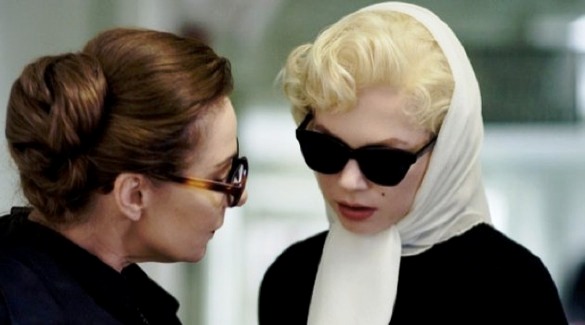
So turns out it’s about this guy, Colin Clark, who wangled a job as an assistant to Olivier and then worked on The Prince and the Showgirl, a film version of a play Sir Laurence had done on stage. In it, the Showgirl was played by Marilyn Monroe, who had bought the property, and hired Olivier to co-star and direct. Here, Olivier is played by Kenneth Branagh and Monroe by Michelle Williams.

I’ve seen The Prince and the Showgirl, actually. The plot is very thin: it’s a little one-situation comedy about a middle-European prince who invites a showgirl up to his chambers with the intention of seducing her, and how she thaws him out through a combination of innocence and (one is led to assume) very hot sex. Olivier plays it with a monocle and a Dracula accent, very stiff and formal, and no humor whatsoever. Monroe looks fantastic, maybe the best she ever looked, and she’s very charming. But they don’t get any chemistry going. Partly because the film is so trivial and empty (the best thing about it is the original poster, which shows Olivier pinning a ribbon on Monroe’s barely-there dress, and the words “Some countries have a medal for everything!”). Partly too it’s the difference in their acting styles: his all cold surface detail and polish; hers warm, spontaneous and messy.

The new movie gets a lot of comedy, in fact most of its comedy, out of this clash. The movie’s Olivier is arrogant, egomaniacal and rude — Monroe thwarts and frustrates him at every turn, and he’s driven half mad by her lateness, her poor memory, her retinue of coaches and enablers. What finally drives him over the brink is his realization that despite her lack of formal acting training, she wipes him off the screen when they’re on it together. (This isn’t really accurate; they both come across vividly in The Prince and the Showgirl, but the film is like a gleaming gold-plated serving dish with a mackerel and a marshmallow sitting on it.) Branagh makes a very funny Olivier, biting down on every last syllable and modulating his voice from a whisper to a roar. He takes many of the Great Man’s mannerisms and gives them a campy spin, for example rolling his eyes toward heaven in supplication, then lowering them suddenly and pursing his lips. He portrays Olivier and sends him up at the same time, and he’s the best thing in the movie.

Michelle Williams is not so juicy. She does an effective, almost eerie job of evoking Monroe, both the wide-eyed mock-innocent dumbbell and the pouting, soulful little-girl-lost. But it’s all evocation. Marilyn Monroe was ferociously, incandescently alive on the screen. It’s not just that Williams doesn’t have Monroe’s looks or her amazing body. She doesn’t have her feral quality, the intense aggressive sexuality that flashes out in moments that are still startling to watch. Like Elvis Presley, Monroe was an extraordinary personality who bypassed traditional notions of “acting.” At her best, as with Olivier, she made conventional acting look stilted and contrived, but at her worst (usually in drama), with no real technique or training to draw on, she could be repetitive, self-involved, and amateurish. Williams is just the opposite — she’s all brains and technique, but no fire. It’s an Indie performance, small and readable and finely wrought. But this is a movie about giants (it also includes portraits of Vivien Leigh, Arthur Miller, Sybil Thorndike) and you can’t help noticing there are no giants around to play them.

In any case, the main character isn’t really Monroe, or Olivier. Like I said, it’s about this guy Colin Clark. The movie is supposedly based on his true story, as recounted in his published diary and in his book The Prince, the Showgirl, and Me. In Clark’s account, as a fresh-faced 24 year old, he was the only one on the set Monroe could relate to, and after her new husband Miller deserted her to return to America, she turned to Clark for comfort. The only person with no agenda, it seems (though he later went on to write two books and sell them to the movies). The central part of the movie is about Colin and Marilyn’s very special week, after they sneak away from the set to go frolicking around the English countryside. They walk aimlessly through a park, they go skinny dipping, she’s turned on by his innocence, and they share a kiss. If this seems like a particularly puerile fantasy involving borrowed bits of The Misfits, Something’s Got to Give and Bus Stop, that’s because it is. You get tired of watching Eddie Redmayne’s Colin stare wonderingly at Monroe, wet eyed and open mouthed, or for variety, the other way around. She opens herself up to him and reveals her hurts, her fears and insecurities, and they fall for each other, sort of. Alas, she has to go back to being Marilyn Monroe and he has to go back to being…well, who cares, really? All they had was their one magical time together, but it’s a time that changed them both. In fact, the movie is named for it: My Week with Marilyn.

What a coincidence, right? Especially considering who I watched it with! When it was over, Halle shifted discontentedly under the covers.

“This thing is unbelievable.”

“Why thank you.”

“Cut it out, Mr. Bond. I was talking about the movie. Harvey may manage to snag Michelle an Oscar, but I don’t buy a word of it.”

She saw my expression, and gave me one of her enigmatic smiles. Then she put her face close. The eternal temptress.

“Could you go for some popcorn?”

“I’d love it, I’m starving!”

“No, seriously, I can’t get out of bed. Go get me some popcorn. Now.”

It was a long week we had together, Halle and me. But I will never, ever forget it.

They Died With Their Boots On

custer05

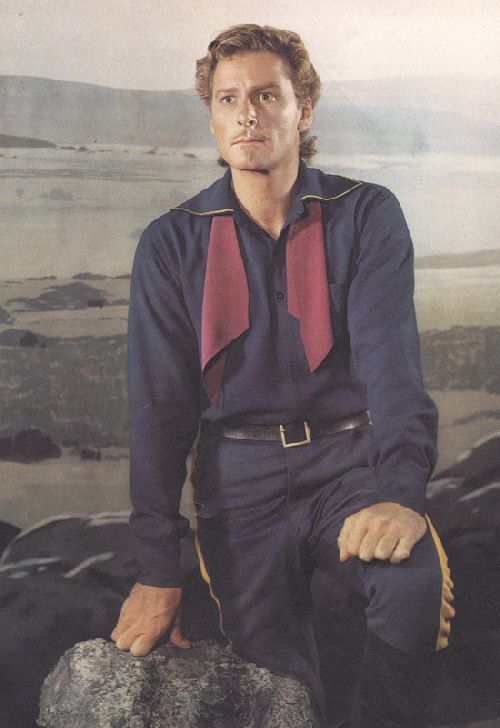
They Died With Their Boots On is the eighth and final pairing of Errol Flynn and Olivia de Havilland. It’s not as famous as some of the others — for example, the pirate swashbuckler Captain Blood or the bejeweled Technicolor storybook Adventures of Robin Hood — but it deserves to be. Those are happy, exuberant movies; this is a tragedy of slowly unfolding power that leaves you unsettled and upset. It’s the rare adventure movie that gets under your skin; it achieves its epic qualities through emotion rather than action. The movie is based on the story of George Armstrong Custer, the general whose command of 500 cavalrymen was overwhelmed by ten times as many Native Americans in 1876. Never were the words “based on” more of a euphemism. As history, Boots On bears only a passing resemblance to actual events — in fact the more you know about Custer, the more outrageous the film’s portrait becomes. Virtually every event is twisted almost 180 degrees in order to turn a vainglorious and highly flawed man into a noble figure.

Yet even as the film moves toward its barroom-painting view of Custer and his men staging their heroic last stand surrounded by savages, it has to explain how he got there. It does so by setting him up as vain, callow, physically daring but reckless and prone to troublemaking. Cleverly, the filmmakers play the first half of the movie as a light comedy, in which Custer gets himself into one mess after another and strikes ludicrous poses trying to act like a bigger man than he is. We see him making mistakes and extricating himself through charm and luck; instinctively we know it’s only a matter of time before that luck runs out.

The fact that the same thing was true of Flynn in real life gives the movie an unusual resonance. He was at least as vain as Custer, and easily as reckless; his road to fame and success was just as fast and fortunate, and left him just as unprepared to deal with real challenges. During the making of this movie, Flynn had a couple of underage girls on his yacht, an escapade that led to a long and embarrassing trial for statutory rape that turned him into a public joke after the premiere — particularly after it was revealed in court that Flynn made love with his socks on. His pre-movie life of adventure had left him with an assortment of chronic maladies that resulted in his being declared 4-F and ineligible for the draft. Because Warner Bros. hushed this up, the public thought him a slacker for not serving in World War II as other stars did. Personal and professional disasters came faster and faster, and his drinking and drug use kept pace. Eventually booze, narcotics, dissipation, and some deeper despair they couldn’t anesthetize, killed him at the age of 50.

Some presentiment of this terrible fate seems to hang over Flynn throughout Boots On. He gives one of his most sensitive and aware performances. His eyes often look wide with fright and he seems more attuned to other actors than usual. Often he pauses and hesitates before taking action, as if genuinely unsure of himself, and when he does act, it’s always a shade too swiftly. He’s as dashing as ever, but often he dashes right into a brick wall. Some of the credit for this must go to the great Raoul Walsh, here directing Flynn for the first time, after the actor had quarreled with his usual director, Michael Curtiz. For the previous seven years, Curtiz had directed Flynn like a toy action figure, throwing him into the middle of clanging swords and galloping horses and trusting him to sail above it all. Walsh’s action scenes were rougher than Curtiz’s, less choreographed and clever, and always suggestive of real threat — as you might expect of a man who had lost an eye in an accident.

At this point in her career, de Havilland had developed some serious ambitions and no longer wanted to be the clinging heroine of Flynn’s boys-own-adventure movies. She only made the film at Flynn’s express request, after they had cleared the air of several years of misunderstanding. By all accounts, including hers, they were seriously in love, but their relationship was undermined continually by his immaturity and instability. Boots On is the only one of their films in which their characters have a real arc, moving from youthful high spirits into a serious relationship, into marriage and ultimately the tragedy of his death. To sweeten the deal for de Havilland, the producer Hal Wallis brought in the fine screenwriter Lenore Coffee for rewrites that rounded out the character of Libby Custer and made her a flesh-and-blood woman rather than a cardboard cutout. De Havilland responds with one of her best and most consistent performances.

In their final scene, she helps him prepare for the battle of Little Big Horn. Both know he’s not coming back, and they can barely look at each other while mouthing cheery sentiments they clearly don’t believe for a second. They’re almost getting away with it when he finds her diary and begins reading it aloud. In it, she confesses her terror over unshakable premonitions of his death. I must have written that every time you left for battle, she says. “Of course,” he murmurs softly. They say their goodbyes and he leaves; she’s rigid against a wall for support. The camera pulls away suddenly from her and she faints from the accumulated tension. Fainting in movies usually is phony as hell, but this time we’ve been holding our breaths too, and it feels like a natural reaction. In real life, de Havilland knew she’d never work with Flynn again, and she felt that he knew it as well. The scene is almost unbearable in its poignancy, for both the characters and the actors. Such is its enduring power that at a screening 40 years later, de Havilland, then about 65, walked out in the middle of it. She went to the lobby, sat down and began to cry.

Suspicion

suspicion

Is he or isn’t he?

That was the question about Cary Grant throughout his life: gay or straight?

This was based, it would seem, on little more than his having shared a house with Randolph Scott in the ’30s and having posed for some goofy pictures of the two of them in aprons and frolicking in the pool. Grant was married five times, had some well-publicized affairs, yet the rumors never stopped, and everyone knew about them. Even my parents. In the early 1960s, they had a live album by Allan Sherman, the singing comedian of “Camp Granada” fame. One of the songs was a riff on a mover and shaker having his secretary call various celebrities, and the big ending went: “And then when you reach Cary Grant, tell him I’d love to, but I just…can’t.” The audience on the album roared; so did my parents.

Around the same time, Tony Curtis did his famous parody of Grant in Some Like It Hot, the humor of which comes not from the accuracy of the impersonation but from the portrait of Grant as a nearsighted, girl-shy millionaire in a silly nautical outfit. Curtis’ very next movie co-starred Grant, so evidently there were no hard feelings. A decade later, when Chevy Chase jokingly used an ugly slur to refer to Grant on a talk show, Grant sued him for slander and won a settlement; later, he was studiously casual about the whole thing. And it continues: a couple of years ago, Grant’s fifth wife Dyan Cannon shot down the rumors yet again in interviews promoting her book about him. But neither Cannon’s testimony, or that of his daughter, his other wives, his former lovers and friends, or anybody else, seems to be enough to put the suspicion to rest.*

Because there’s something about Cary Grant. Whatever he projects at any given moment, he somehow manages to suggest something else at the same time. He’s remembered as the epitome of class and style, but with his strange, not-quite-Cockney accent and thick features, he’s clearly no aristocrat. In his screwball comedies, he projects anger and a kind of general threat to the other actors. His spills and pratfalls are clearly the result of enormous physical mastery and athleticism. Playing heroes in adventure films, he’s a joker and a clown. In love scenes, he’s quizzical, wary, amused — anything but ardent. Often his eyes, his smile, the tilt of his head seem to convey something quite different, and usually more intelligent, than the dialogue coming out of his mouth.

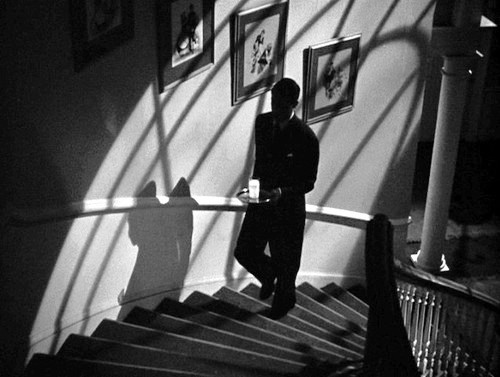
Which is why Johnnie Aysgarth in Alfred Hitchcock’s Suspicion is in many ways the ultimate Cary Grant role. Johnnie is married to Lina, a wealthy spinster from a small English village. He puts the moves on her and they marry quickly, but soon his evasions and subterfuges cause her to have doubts about him. He may have married her for her money (her father thinks so) and be planning to murder her for it too. Or he may be a misguided, misunderstood underdog who’s uncomfortably adjusting to life with a woman who has more money than he does. Is he or isn’t he guilty, that’s what the entire movie is asking. It’s not spoiling anything to tell you the ending (he isn’t), because it satisfied neither the cast, writers, director, original audiences, or virtually anybody else who has seen the movie since its premiere 70 years ago. Everybody struggled with it during the writing and filming — nobody could come up with the right ending. Because there’s no way to resolve this particular story. Suspicion is about something inexplicable: Cary Grant’s personal ambiguity, his elisions, his ultimate mystery.

Joan Fontaine won the Oscar for playing Lina, an award generally assumed to be a consolation prize for her losing the previous year for Rebecca. She basically repeats the performance here, but with more flattering makeup, hair and clothes, and with a veneer of movie-star graciousness that probably drove Hitchcock a little crazy. Making Rebecca, he had used a variety of psychological tricks on set to undermine her confidence. Here, he improvised a nickname for Grant to call her throughout the film: “Monkeyface.” It’s like a slap every time he says it; he might as well be calling her “shithead” in that musical voice of his. Let it be said for the record that Joan Fontaine is beautiful and looks nothing like a monkey, but her role gives her little to do other than suffer and look elegantly worried while keeping a stiff upper. (Lina was a little more masochistically interesting in the original novel, “Before the Fact,” in which she’s correct about her husband’s motivations but so in love with him that she knowingly drinks the glass of poisoned milk he brings her.)

Grant’s real romance in Suspicion isn’t with Fontaine anyway — it’s with Nigel Bruce as his old friend Gordon Thwaite. Considering his snub nose, he has an inappropriate nickname too: “Beaky.” In the 20 years Bruce mumbled and bumbled around Hollywood, he was never more appealing than in this part. Beaky always says the wrong thing and reveals Johnnie’s tricks and lies, and then hangs his head as both the angry husband and the offended wife slap him around. Bruce and Grant get a real performance rapport going — they play their relationship as if Beaky was a big overgrown dog and Johnnie his affectionate but exasperated master. When Beaky has a brandy-induced choking fit and Johnnie stops Lina from coming to his aid, Grant is expertly unreadable. Is he frozen with concern, or callous indifference?

70 years later, it’s not easy to appreciate what a daring performance this was in 1941. Grant had just come off the greatest string of movies any actor ever had — Topper, The Awful Truth, Bringing Up Baby, Holiday, Gunga Din, Only Angels Have Wings, The Philadelphia Story, His Girl Friday — and was now one of the biggest stars in Hollywood. What was bold of Grant was to take the charm that had brought him to the top and suggest that it might in fact be a cover for any number of repellent qualities. Johnnie is handsome, smooth, and commanding, but he’s also a chronic fibber, con man and embezzler… a spider, as the photo at the top suggests. Essentially it’s the darkest role Grant ever played. And though the director claimed (probably falsely) that the studio forced it on him, Hitchcock’s “happy” ending (as with many of his happy endings) is anything but. Lina blames herself for everything, but she’s still married to a man who lies at the drop of the hat and steals money every chance he gets. Johnnie has explained everything away, but he’s still married to a woman who knows what he’s capable of and shrinks from his touch. Contemplating the future of their relationship is actually the scariest thing about Suspicion.


* Why does everyone need Grant to pick a team? Haven’t they heard of bisexuality?   

Viva Las Vegas

A-M and Elvis

Today, Tomorrow and Forever

It’s not difficult to imagine the reaction of Colonel Tom Parker watching the rushes of Viva Las Vegas in early 1964. There he is: Elvis, his only client, His Boy, up there singing and dancing and gyrating as usual. But there’s something wrong. He’s way back in the back of the shot, almost a stick figure back there. Right up in front of the camera, looming in the foreground, taking your eyes inexorably away from him, is Ann-Margret. Or rather, clad in a skin-tight dress and wiggling in unison, Ann-Margret’s butt. I bet the Colonel damn near bit through his cigar.

In fact, Colonel Parker hated Viva Las Vegas. He peppered the MGM front office with complaints: the girl was stealing the picture; she had too many songs and too many close-ups; the director was favoring her and kept adding new material for her; the publicity was all about this great teaming when everybody knew Elvis was the one and only star and doing just fine on his own. Worst of all, the fancy production values and re-shoots were sending the picture over budget, cutting into Elvis’ share: a half-million in salary and 50% of the profits, of which the Colonel was taking 25%.

As usual when it came to anything but cutthroat dealmaking, the Colonel was wrong. Not only was Viva Las Vegas the biggest hit movie of Elvis Presley’s career, but it survives as one of the best of them, and probably the most sheerly enjoyable. It’s not the best movie as a movie (by common consent, that’s King Creole), or the one that presents the essence of Elvis best (that’s Loving You, an under-appreciated minor masterpiece). Vegas’ script is pathetic, its characters one dimensional, its acting perfunctory. Amazingly, it manages to do almost nothing with its ostensible subject (auto racing) or its gaudy setting (despite the title song, performed three times). What makes it great is what the Colonel hated most about it: Her.

What a difference a co-star makes. Unlike most of Elvis’ leading ladies, Ann-Margret doesn’t seem even slightly afraid of him. And she doesn’t make the mistake many of them made, trying to tune into his vulnerable side and get some kind of tender thing going. She’s a tigress. At only 22, she’s a tight little bundle of sheer talent that keeps threatening to burst its seams. She’s so gorgeous she’s like a special effect — days after watching the movie you can’t get her figure or her huge mane of red hair out of your head. Normally Elvis looked at everything and everybody in his movies with the same expression of polite, amiable inattention. But throughout this movie, he reacts to Ann-Margret with something close to astonishment, and his habitual good ol’ boy smirk is replaced by what can only be described as delight. Their chemistry blows the movie to smithereens.

Her energy and his response to it infuse their musical numbers with playfulness and real sexual give and take. The first of them, “The Lady Loves Me,” is set around a hotel swimming pool, as he sings about how hard to resist he is, and she puts him down mercilessly. The lyrics make him out to be pushy and egotistical, qualities Elvis doesn’t project at all, but he makes it work with light self-mockery and the insistence of his attention toward her. By their second number, “C’mon Everybody,” she’s dancing along as he sings, looking up at him undisguised adoration. Her character isn’t supposed to be that much in love with him at this point in the movie, but at this point in the movie, who gives a damn about the script? Not these two, and certainly not us. By the time they dance together near the end — to something called “The Squat” and then to Ray Charles’ “What’d I Say?” — they’re locked in on each other to the exclusion of everything else. The intimacy is so overwhelming you feel like a voyeur.

You feel the same way listening to the two other duets they recorded for the movie. “You’re the Boss” is a great Leiber and Stoller song in which a man and woman trade teasing compliments about each others’ bedroom prowess — the inverse of “The Lady Loves Me.” Leiber was a masterful American lyricist whose style owed something to E.Y. Harburg — both writers were great observers of human foibles, both had sly and witty senses of humor, and both joyfully celebrated the ways sexual attraction makes a person look, act and feel ridiculous. Plenty of Elvis songs simmer with sex, but with Ann-Margret purring and growling along with him, “You’re the Boss” is in a class by itself.

The other duet, “Today, Tomorrow and Forever,” is a love song in standard Elvis ballad style, tremulous and slow. It’s not much of a song, but their rapport lifts it to an almost spiritual level. You can feel the emotion of their real-life love affair in this song, just as you could feel it in the interview she gave Charlie Rose 30 years later, gently but firmly maintaining their privacy as a couple.

You won’t hear either of these performances in the movie, however: the Colonel had the ballad re-done with Elvis singing alone, and the other cut entirely. The soundtrack album didn’t even have Ann-Margret’s name on it. “You’re the Boss,” indeed.

There wasn’t much else the Colonel could do about Viva Las Vegas though; the picture had gotten out of his control and was a total loss as far as he was concerned. However, he had learned his lesson. After shooting wrapped, he signed with Sam Katzman, a producer with absolutely no taste but an ironclad commitment to bringing pictures in under budget. A kindred soul. From now on, Elvis movies would have lower costs, tighter shooting schedules (two weeks, down from the 11 weeks spent on Vegas), hand-me-down songs, no big production numbers, and nobody of sufficient talent to turn the boy’s head. In his next picture, Kissin’ Cousins, he would be his own co-star — he played an Army man who discovers a look-alike hillbilly cousin in the backwoods mountains, tackily re-created on a soundstage. The psychological effect of this doppelganger plot on a man with a dead twin brother and a deep inferiority complex can only be guessed, but it was a glum shoot and there were times Elvis refused to leave his dressing room.

Kissin’ Cousins cost only $800,000 to make, and earned $2 million in profit. Now there, the Colonel must have thought as he fondled his cigar, that’s a picture.